By Juli McShay
Forward Times
https://www.forwardtimes.com/
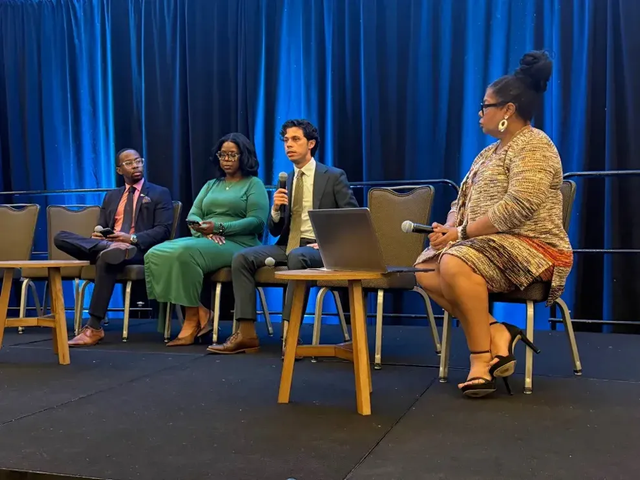
At the Congressional Black Caucus Foundation’s 55th Annual Legislative Conference in Washington, D.C., I expected to hear urgent conversations about the issues facing Black America. I did not expect one of the most urgent to need its own space outside the planned sessions.
Civil rights attorney Lee Merritt and the Rev. Dr. Jamal Bryant hosted a “Stop the Lynchings” panel after discovering that no session was scheduled to address the issue, even as members of the Congressional Black Caucus had spoken out about reports of Black people found hanging across the country. The annual conference brings lawmakers, advocates and community members together to discuss policy affecting Black Americans. This conversation belonged in that room.
I spoke with Merritt before the panel and asked why it was important to bring people together on this issue.
“We live in a country that has a sordid history of terrorism and lynchings, and that demon has resurfaced recently in clusters of bodies being found in North Carolina, Florida, Georgia, Texas and all throughout the South and some northern cities as well,” he said. “And it’s being underreported. Sometimes, it’s being misclassified scientifically as suicide.”

Merritt said the panel would hear from forensic scientists about proper death investigations and from mental health experts about suicide among Black people. He also had a blunt response to how some deaths have been explained: “Listen, Black folks don’t hang themselves by the neck.”
That is Merritt’s assertion, and it reflects the alarm he brought to the conversation. The panel did not avoid the subject of suicide. It asked whether investigators are doing enough to distinguish suicide from other causes of death when a Black person is found hanging, and whether families are getting answers they can trust.
Merritt wants more than another conversation. He called on the media to report these cases, on medical examiners and forensic professionals to examine Black deaths with integrity, and on the federal government to act.
“We are asking the executive branch, the president, to create an executive order, similar to what he passed for Native Americans,” Merritt said, referring to Executive Order 13898, which established a task force on missing and murdered American Indians and Alaska Natives. “We want direct immediate federal action. We want action from the Department of Justice, who seems to be focused on everything but justice.”
Journalist April Ryan moderated the discussion among journalists, scientists, mental health experts and civil rights attorneys. They spoke about deaths over the past 25 years that families and advocates believe deserve renewed scrutiny, and about the harm an inadequate investigation can do long after a case is closed.
Tunisha Brown, founder and publisher of IMPACT magazine, offered a definition of modern lynching as a discriminatory killing motivated by race, gender or sexuality. When an attendee asked what language might give people hope as they discuss these deaths, Brown pushed the room to think beyond a phrase.

“I would use more than language. I would use the actual people who are doing the work as evidence,” Brown said. “Instead of us focusing on the word, we should be focusing on the work.”
Public health expert Dr. Michael Forde spoke about the need to put human stories alongside the data people share online.
“Data by itself doesn’t help as much as the humanization of it, which is story telling,” he said. “And from my experience, when I talk about anything else but lynching, it falls on deaf ears. Lynching creates a visual image. Something that’s visceral, you feel it.”
Forde urged people not to soften their demand for answers to make others comfortable. “We are unapologetic about standing up for justice. We are unapologetic about standing up for rights. We are unapologetic about standing up for the things we want to change,” he said. “We will be the change that we want to see. That is hope.”
When I spoke with Bryant, he was equally direct about the political climate. “I think that the Trump administration has emboldened alt-right white supremacy,” he said to Forward Times. He described the reports of Black people found hanging as painful and humiliating, and called for the country to confront what families and advocates say has gone uninvestigated.
I asked Bryant what message he had for Black men at this moment.
“We must move in community and stand with one another,” he said. “I think that’s our challenge moving into this midterm election. Go out and vote, and protect each other.”
That demand for federal action was already reaching Congress. Earlier this month, U.S. Rep. Jasmine Crockett of Texas asked the Department of Justice to investigate reports of Black Americans found hanging from trees and other structures. She called on federal investigators to examine whether deaths treated as isolated incidents, including cases ruled suicides by state and local authorities, might reveal racial animus or failures in the investigations themselves.
“America spent generations allowing Black people to be lynched while institutions with the power to intervene stood by and did nothing,” Crockett said. “We cannot repeat that history. The DOJ has the authority, the resources, and the responsibility to determine whether these deaths are isolated tragedies or evidence of something far more sinister. I am demanding that they use them.”
Days later, U.S. Rep. Ayanna Pressley led a letter to Attorney General Todd Blanche and FBI Director Kash Patel demanding federal investigations into reports of Black people found hanging nationwide. Crockett signed it, along with Houston-area Reps. Al Green, Christian Menefee and Sylvia Garcia. The lawmakers called for independent autopsies with families’ permission, audits of local and state investigations, reviews of evidence, reports to Congress and systematic data collection.
These are not abstract requests. They are steps that could establish what happened in individual cases and expose failures where they exist. Families deserve that work. Black communities deserve that work. And those entrusted with the power to investigate should not need another generation to tell them why.
Brown said we should focus on the people doing the work. Merritt demanded federal action. Forde called on us to stand up without apology. Bryant urged us to stand together. Their words were different, but the demand I heard was unmistakable: Do the work, follow the evidence and give these families answers.
Juli McShay is a government professor at San Jacinto College specializing in constitutional law, civics and voting rights. She is the founder of the Houston Civics & Leadership Campaign School, host of the Pretty Petty Politics podcast and a political contributor for Forward Times.