Ninety-five percent of early Black Census respondents say they will vote this November. Only 3 percent trust the federal government. The distance between those two numbers is the story of this midterm.
By Shelby Stewart
Essence
https://www.essence.com/
Xinhua News Agency
With the midterm elections just weeks away, Black voters are telling researchers the same two things at once: we are showing up, and we do not believe the system has earned it.
The finding comes from early results of the 2026 Black Census Project, released by Black Futures Lab. Drawn from the first 6,000 respondents, who live in all 50 states and the District of Columbia, the data offers one of the largest portraits of Black voters in a midterm year.
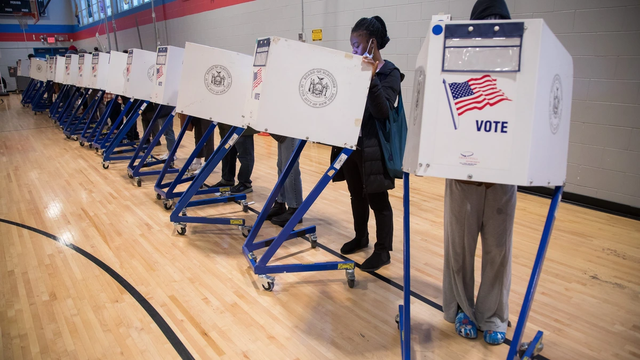
The headline number is commitment. Ninety-five percent of respondents say they intend to vote in 2026, and that resolve cuts across generations. Among respondents under 30, 95 percent plan to cast a ballot as well.
Then comes the second number. Just three percent of respondents say they trust the federal government. Trust in Black elected officials is higher, at 22 percent, but it is still far from a vote of confidence. Respondents also reported low trust in U.S. Immigration and Customs Enforcement and in elected officials more broadly.
Read together, the figures describe voters who are not casting ballots out of faith in the institutions on the other end. They are voting anyway, and many appear to want more than a ballot can deliver.
That shows up in one of the survey’s more striking findings. Among respondents who expressed little trust in government, 23 percent said they would abolish the Electoral College. Black Futures Lab reads that as a sign that many people are looking past participation alone toward structural changes that could make democracy more responsive and representative.
“Black political power is more than a turnout number on Election Day,” said Kristin Powell, executive director of Black Futures Lab. In her framing, that power is built when Black people are heard, when their experiences and priorities shape public policy, and when elected leaders stay accountable to their communities between elections.
The census also asked what Black people hope for, and the answers read less like wish lists than like a call for breathing room. Respondents could name more than one dream. Here is what rose to the top.
Forty-four percent dream of becoming debt-free, and 41 percent dream of improving their physical health. Another 35 percent dream of earning more money, 25 percent of living in safe, affordable housing, and 23 percent of owning a home.
Debt, health, income and housing: the survey points to a community weighing the rising cost of living on every front at once, and hoping for stability more than anything flashy.
Rev. Dr. Starsky Wilson, president and CEO of the Children’s Defense Fund, a partner on the project, connected those hopes to the next generation. He noted that Black children are more likely to live in poverty, to experience hunger because of SNAP cuts, and to go without health care because of cuts to Medicaid. “The highest use of any community’s power is to wield it on behalf of their children,” he said, urging people to vote, volunteer and lift their voices for policies that put young people first.
Launched in March 2026, the Black Census Project is the largest Black Futures Lab has undertaken. Its goal is to reach 300,000 Black respondents nationwide by 2027, building on the organization’s long-term work to turn Black communities into constituencies capable of changing how power operates at the local, state and national levels.
“Black communities are navigating economic uncertainty, political attacks, and systems that too often disregard our needs and aspirations,” said Natishia June, the organization’s deputy executive director. She called the census a chance for Black people to define the future they want and to demand that decision-makers meet the urgency of the moment.
The early sample skews toward older respondents. Baby Boomers make up 37 percent, followed by Gen X at 30 percent, Millennials at 23 percent, Gen Z at 8 percent and the Silent Generation at 3 percent. Women account for 61 percent of respondents and men for 35 percent.
Those figures call for some care. They come from the first 6,000 participants of an ongoing, preliminary effort, and they represent people who chose to respond, not a random sample of Black America. Think of them as a snapshot of an engaged community, not a verdict on every Black voter.
But as a signal heading into November, the message is hard to miss. Black voters plan to be there on Election Day, and they are keeping watch on what comes after it.