A mother reflects on the opportunities and racial harm her son experienced at predominantly white schools, asking what Black children sacrifice for access to education.
By Dr. Karsonya Whitehead
Afro
https://www.afro.com/
Recently, Nikole Hannah-Jones wrote an essay in The New York Times Magazine that has stayed with me. She reflected on a choice she and her husband made ten years ago about where their daughter would go to school. She chose a mostly Black school because she believed in the collective responsibility to challenge segregation and educational inequality. Years later, their daughter asked the questions that every parent dreads: Did you know? Did you know what I was losing when you made that choice for me?
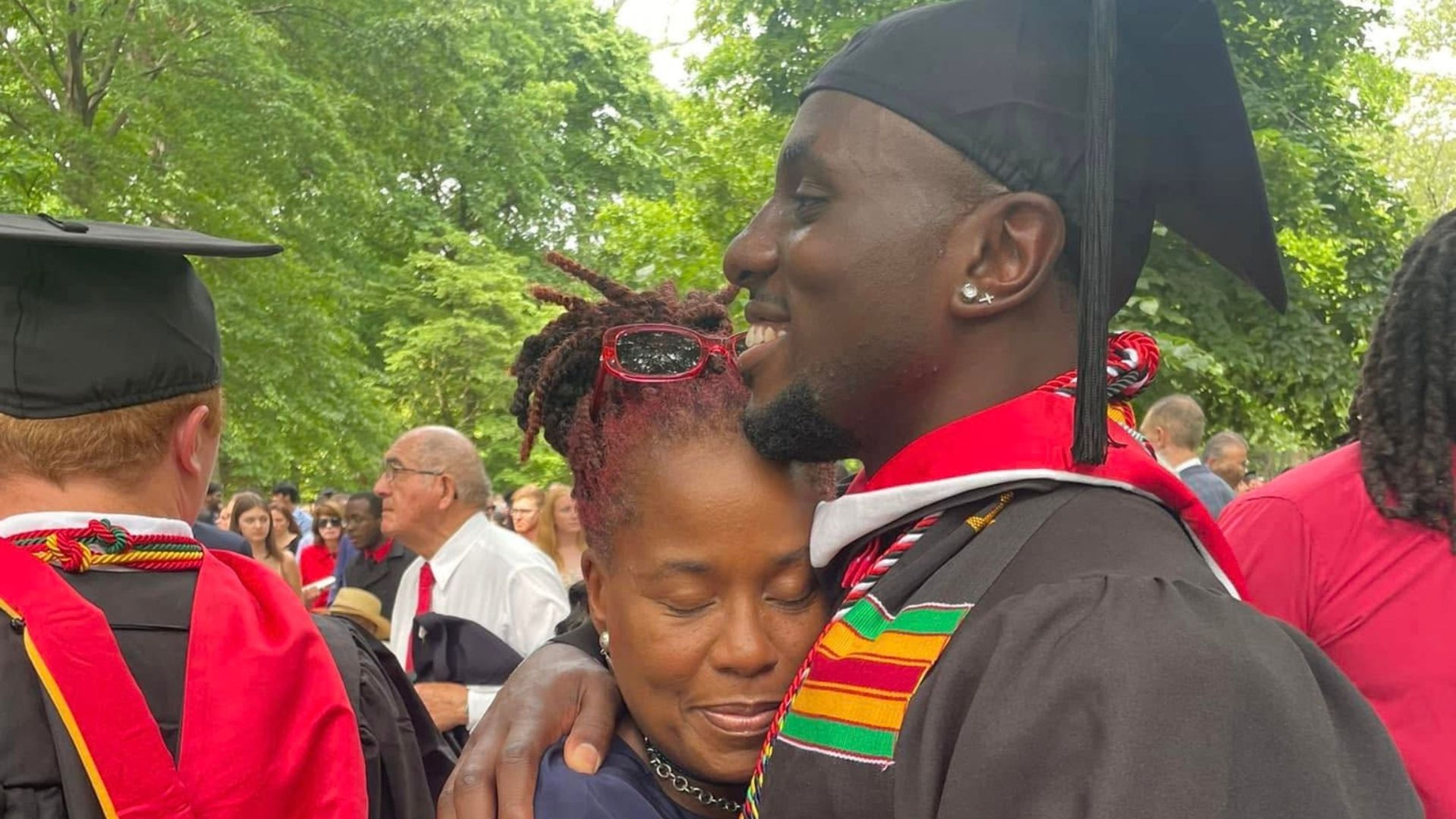
Dr. Karsonya “Kaye” Wise Whitehead is a historian of Black life in America, a professor at Loyola University Maryland, and the host of Today With Dr. Kaye on WEAA. She is also the 30th president of the Association for the Study of African American Life and History (ASALH). Shown here, Whitehead, with her son, Kofi.Courtesy Photo
Hannah-Jones does not offer herself an easy answer. Neither will I. I read her essay and immediately thought about the choice my husband and I made in the opposite direction.
We sent our sons to predominantly white private schools. We wanted what most parents want.
A strong education. Opportunity. Preparation. Access. As a former Baltimore City public middle school teacher, I knew some of the challenges they might face, and I wanted to protect them and prepare them.
We simply wanted them to have a good education.
What I knew then
My oldest son, Kofi, was six years old the first time I watched him discover that being Black might make him a target. He was in first grade at an independent school in Baltimore. One day during recess, some of the boys created a game. They called it: “Let’s Get the Black Boy.”
There was only one Black boy in the grade.
My son.
So, he ran. Years later, I wrote about that day. I remembered the car ride home, when he asked me so many questions. What did it mean to be Black? Was being Black something we chose? My husband and I talked late into the night about what it meant for him to run and what might have happened if the boys caught him. And where were the teachers? That night, while my six-year-old tried to understand his Blackness, I stood in front of the mirror, getting ready to confront his teachers and his school. I practiced what I would say and tried to find the courage to say it. I also remembered what my father taught me: when we face racism and injustice, staying silent can be its own kind of complicity.
I did not realize it at the time, but my son was starting two kinds of education. The school taught him academics. America was teaching him about race. I was trying hard to help him get through the second without losing what he could gain from the first. This is not new. Black people in this country have always had to learn both. I was seven when someone I thought was my best friend called me the n-word. I did not even know what it meant until I told my Nana, who then had the same talk with me that I was now having with my son. I used to think, maybe foolishly or hopefully, that the conversation about being Black in America would end with me. I was wrong then, and I am still wrong now.
What my son knew then
Ten years later, Kofi told the story himself. On November 17, 2017, The Washington Post published his essay: “At my Baltimore school, we played ‘Let’s get the black boy.’ I was the black boy.” He was almost seventeen. What struck me then, and still does, is that he remembered what the other children probably forgot. He remembered running. He remembered being the only Black boy. He remembered learning that there were really two communities at his school: one inside the classroom, where teachers tried to include him, and another outside, with weekend gatherings and playdates where our family was rarely invited. He also wrote something I think about often. He said he was still running against that six-year-old boy.
But he also made himself a promise. If he faced racism again, he wanted to stand instead of run. That line means even more to me now, because racism did find him again.
And then came college
Kofi went to Rhodes College. Another predominantly white institution. And in September 2021, a banana was taped to the dorm-room door of Black students he knew. By then, my son was no longer the six-year-old boy running across a playground. He was president of Men of Distinction, a Black male student organization on campus. And this time, he stood. He spoke publicly. He challenged the institution. He pushed for a stronger response. He told local reporters that students of color at predominantly white institutions can learn to keep their heads down and continue moving forward. But this time, he said, they were planting their feet and saying: Enough is enough.
Six years old in elementary school: Run.
Almost seventeen in high school: Write.
Almost twenty in college: Stand.
There is a temptation here to shape this into a beautiful story about resilience and courage. I refuse to do that.
Racism did not make my son strong. He became strong even though he had to face racism. That is not the same thing. No Black child should have to be chased on a playground to learn courage. No Black teenager should have to explain racism to white classmates to find his voice. No Black college student should have to face racial humiliation to become a leader. We can be proud of what our children become without pretending that everything they went through was needed for them to grow.
So, was it worth it?
This is where the question gets complicated. Because I cannot honestly tell you that sending our sons into predominantly white educational environments was simply a mistake; it was not.
Kofi finished eighth grade at Calvert School, graduated from Gilman School, and then from Rhodes College. All of these were mostly white schools. He got opportunities, met people who broadened his view, grew intellectually, and built relationships. He also learned about himself and the world. Now, he can look back and appreciate much of what those schools gave him. We also made sure to create cultural experiences outside of school. Through friends and family trips, he was surrounded by Black people who loved, encouraged, and truly saw him. He learned Black history, studied Black art, read books by Black authors, and went to Homecoming at Lincoln University (my HBCU). He was surrounded by the richness, beauty, and brilliance of Black culture in America.
And yet, I am his mother.
And because I am his mother, I also remember what those schools asked him to carry.
Maybe this is where the conversation about Black children and education gets more complicated than the choices we often give parents: public or private, mostly Black or mostly white, neighborhood or selective, integration or community, opportunity or belonging.
What if those are not the only questions? What if we also need to ask: What does this school ask my Black child to give up in exchange for what it offers?
What I know now
Nikole Hannah-Jones’s essay made me think about all this again because, on the surface, our choices seemed opposite. She chose a mostly Black school because she believed in the power of integration and equity. We chose mostly white schools because we thought they could give our sons certain opportunities. Different choices. Different sacrifices. The same heavy weight of Black parenthood. Black parents do not make school decisions without thinking about history. We know what Brown v. Board promised, what segregation created, what integration did and did not fix. We know some mostly Black schools have been denied resources. We know that getting into mostly white schools does not always mean our children will belong. And we know our children live with the results of choices we make when they are too young to choose for themselves.
I wish I could say there is a formula, but there is not. I wish I could tell you what I would tell every Black parent to do, but I cannot. Maybe that is not the real question. My son is grown now. He graduated from college and is now married and building his life. He understands his education with a depth that neither of us had when he was six.
But I still picture that little boy sometimes, running across the playground, trying to get away from kids who turned his Blackness into a game. Ten years later, he wrote that if racism found him again, he wanted to stand. The next time came, and he did. I am very proud of him. But pride does not answer the question: Why did he have to learn that lesson at all? Maybe when we talk about choosing schools for Black children, we need to ask more than which school can give them the most. We also need to ask what our children may be required to give up receiving it.
And perhaps the hardest part of Black parenting is understanding that despite what we hope, there is no choice that we can make without sacrifice.
This commentary is the first offering of a two-part series. Read more on AFRO.com
The opinions expressed in this commentary are those of the writer and not necessarily those of the AFRO.