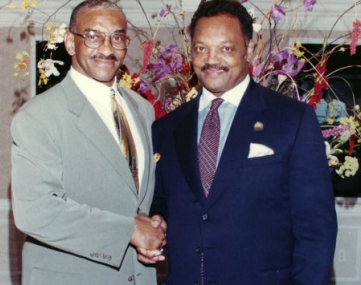
For more than a century, the Houston Street Viaduct has connected downtown Dallas with Oak Cliff. Now, supporters of a proposal to rename the historic crossing for Pettis Norman say the bridge could serve another purpose: connecting future generations to a man who devoted his life to bringing people, communities and institutions together. The Dallas City Council is scheduled to hold a public hearing on a proposal to rename the Houston Street Bridge, between Zang Boulevard and Young Street, the “Pettis Norman Bridge.” The proposal has already received the endorsement of the Dallas City Plan Commission. There were no objections from the Street Name Coordinator, the Park and Recreation Department, or Dallas ISD. The Department of Transportation said an amendment to the Thoroughfare/CBD Plan would be required, and city staff, before registering their approval, noted that waivers are needed for names exceeding 14 characters and for names honoring someone who died within the past two years. Norman, who died last year at age 86, was known nationally as a tight end for the Dallas Cowboys and San Diego Chargers. In Dallas, however, his impact extended far beyond football. He was a businessman, banker, real estate investor, education champion, and civic leader who worked across racial, political, and economic lines. To those who knew him best, naming a bridge in his honor is more than a tribute. It reflects how he lived. “Anything that’s connective, whether it’s dialogue, a bridge or a program, connected to Pettis Norman just makes a lot of sense to me,” said Calvin Hill, the former Cowboys player who regarded Norman as a teammate and mentor. Hill, who joined the Cowboys in 1969, said he initially knew Norman through film sessions. He remembered watching Norman block with such power that the rookies were in awe. When the veterans arrived at training camp, however, Hill encountered a man very different from the ferocious player he had seen on film. Norman encouraged young players to prepare for life beyond professional football. He also introduced Hill to experiences outside his comfort zone, including taking him to his first country and western concert, featuring Charley Pride at the Longhorn Ballroom. “Pettis was always a guy who used to tell me, ‘You’ve got to expose yourself to things that are different because you may like it,’” Hill recalled. That commitment to crossing racial and cultural boundaries defined Norman’s public life. During his Cowboys career, he challenged the practice of assigning hotel roommates by race. According to Tom Dunning, a longtime friend and civic colleague, Norman took the concern directly to head coach Tom Landry, insisting that players who competed as one team should not be separated when they traveled. The Cowboys ultimately ended the practice. Dunning said Norman used his visibility and the respect he earned as a Cowboy to push for change throughout Dallas. “The important thing is not that he was a great athlete, but that he was a true bridge builder,” Dunning said. “He used the platform of being a wellknown and well-respected member of the Dallas Cowboys to express his concern about how the city was going and how DISD was going. He was looking to make things better, not to criticize.” Former Dallas ISD Superintendent Michael Hinojosa first knew Norman as one of his childhood football heroes, a dependable player who handled the blocking and made important catches. Years later, Hinojosa worked with him through Dallas Achieves as the district sought to build systems for student success. “To me, he’s a bridge builder, and he’s just like that Houston Street Viaduct,” Hinojosa said. “He’s the bridge between North and South.” Hinojosa described Norman as a connector who offered “tough love” and was willing to create what the late congressman and civil rights leader John Lewis called “good trouble.” Norman, he noted, was also among the few Cowboys players of his era who made his home in the southern sector of Dallas. A friend and comrade in the movement, Dallas County Commissioner John Wiley Price called Norman a “renaissance man” whose bridge-building was significant in his entrepreneurial efforts as well as his civic service. “He built houses. He built businesses. He built relationships. He also bridged the gaps,” Price said. “That was just Pettis Norman.” Real estate developer Terrence Maiden, CEO of Russell Glen Company, said Norman’s hopes for southern Dallas continue to live on. “His vision and impact for southern Dallas were very admirable,” Maiden said. “I think his legacy embodies the sort of leadership principles that I look to display daily in my work as a real estate developer and investor.” Former Dallas Mayor Mike Rawlings said the proposed honor recognizes Norman as one of the city’s most important community leaders. “He represented the very best of Dallas,” Rawlings said. “It’s very appropriate because it’s a bridge that connects two parts of our city, downtown and Oak Cliff, and that’s the type of person he was. He connected people.” Supporters acknowledge the structure’s history but contend that Norman’s name would add meaning to a landmark built to unite two parts of Dallas. He worked tirelessly to make this city and this world a better place. The bridge renaming effort is deeply personal for Norman’s widow, Ivette Norman, who began pursuing the honor in March with guidance from former Dallas City Council member Casey Thomas. Mrs. Norman said a street did not.