By Aria Jones
Dallas Morning News
https://www.dallasnews.com/
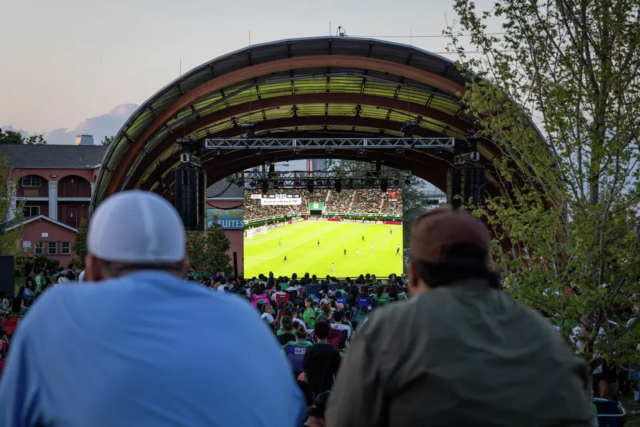
Cars and pedestrians swarmed an Oak Cliff neighborhood as Dallas police directed FIFA World Cup fans carrying folding chairs, strollers and kids across the Interstate 35E service road.
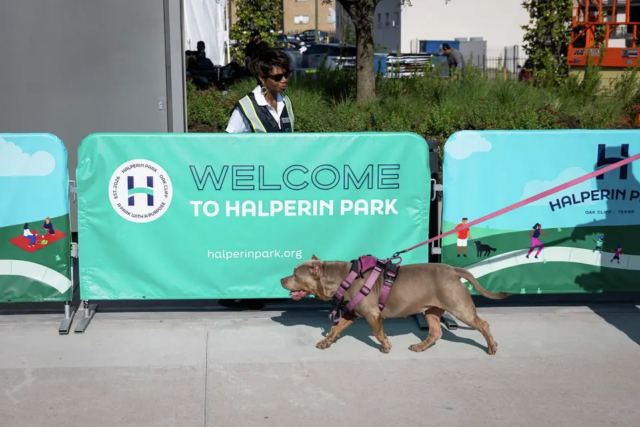
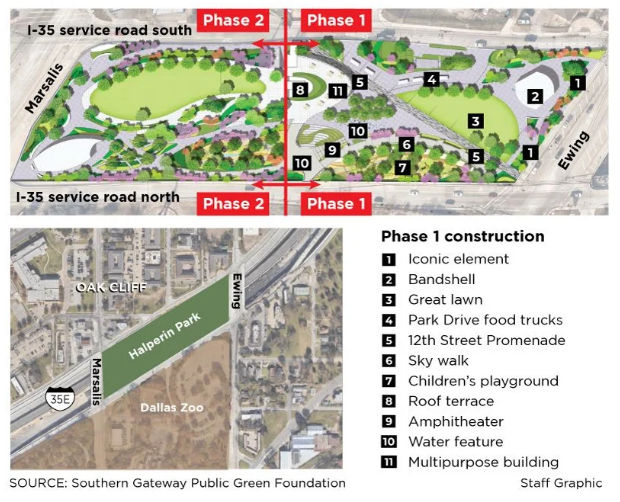
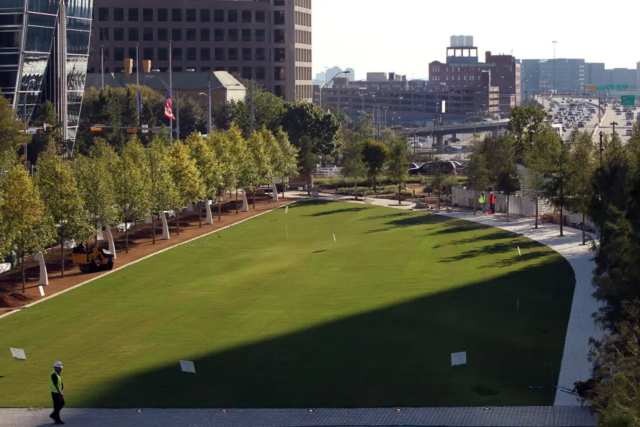
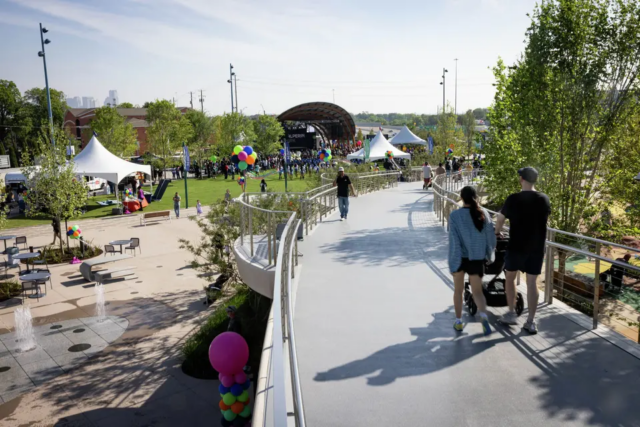
Hundreds gathered on a grassy concrete structure above the highway for the Mexico vs. South Korea watch party at Dallas’ new public greenspace, Halperin Park — an estimated $300 million investment aimed at mending communities long fractured by the road below. For some, the park has not only emerged as a gathering space, but a symbol of renewed interest and investment for neglected corners of southern Dallas.
“I feel like there was not a lot of attention over here, but now we have this big park,” said Stephanie Hernandez, who visited the watch party from her nearby home. “We’re seen.”
Gazing at the sea of fans, she said the park was an acknowledgement from the city. Early estimates boast a massive economic impact — $1 billion over the first five years. That’s if the nonprofit running it, the city and area developers do their part in activating the space, handling needed infrastructure and balancing the effects of growth.
Parks, championed by Dallas Mayor Eric Johnson, offer benefits to communities’ economic growth, health, sustainability and connection. Deck parks, with a much larger price tag, take measures a step further by adding green space — often to areas ripped apart by highway construction in decades past.
Otherwise known as cap or lid projects, the structures are built over roadways to form bridges or decks. Parks can then be designed to fill the limited space on top with greenery, amenities or buildings.
Like cities across the country, Dallas is using these projects as a tool to bridge neighborhoods and spark economic growth. It’s not always clear how well the new structures achieve their goals, especially in the long term, research shows. Dallas’ first deck park, Klyde Warren in Uptown, saw early success. The massive impact was enough for some Oak Cliff residents to call for one of their own.
“We believed over a decade ago, the city could do better for Oak Cliff,” said Paul Carden, a community member who advocated for the park, when it opened.
Some have concerns about gentrification, while Halperin’s supporters say its benefits are maximized because its design, programming and location are tailored to the community. Nationally, deck parks have emerged as a sort of compromise for past harms.
“Dallas is lucky because of the topography and the way the freeway is done,” said Diane Jones Allen, the landscape architecture program director at the University of Texas at Arlington. “In a case like this, where the freeway is sunk in, and you can knit [neighborhoods] together — that’s kind of rare.”

Tenth Street’s history can’t be undone
Communities that ended up with harmful infrastructure were often in places where residents didn’t have the political power to resist, Jones said.
“These freeways are going from suburbs into cities and intentionally, or sometimes unintentionally, went through swaths of more vulnerable populations,” she said. “Eventually, people start thinking about, ‘OK, how do we remedy this?’”
When Interstate 35E was built, it sliced through the heart of the historic Tenth Street neighborhood, once a bustling freedman’s town. In the decades that followed, the neighborhood has lost historic structures. Crumbling sidewalks and overgrown lots pepper the neighborhood. With the addition of the park, residents are thinking about what could change.
Cedric Junius, 45, said when he and his wife moved into the area in 2021, he didn’t know the park was coming. Junius, who works in the insurance industry and co-owns a catering business, hopes that the spotlight on the park encourages the city to deal with the area’s issues such as homelessness and street repairs.
“More improvements have been done in the last year versus the first four years we’ve been here,” Junius said.
Overall, he sees how the new park could attract investment, but he has concern for his neighbors, whom he doesn’t want to see pushed out by rising property taxes when developers start taking interest. He said consistent community involvement will be key in ensuring area neighborhoods, not just their visitors, use and benefit from the park.
Despite gentrification concerns, Kenneth Thomas called the park “one of the best investments made for the area by the city.” At 61, Thomas said he is finally seeing investment coming south after living in the area his whole life.
Thomas, a truck driver, has gone to the park three times since it opened in May. Thomas was quick to note a nearby development, East Dock. The more than 100-year-old property is now home to restaurants and offices, where Thomas orders food such as sushi, which he’d normally head north for.
“I can ride my bike now and get that same experience. It’s a wonderful feeling,” he said. But Thomas said the park’s acknowledgement of history can’t fix what was damaged.
Several Black families have already moved away since the highway cut through the neighborhood in the 1950s, Thomas said. Other residents died. As new residents move in, he said the park may not help those harmed but may benefit the new and diverse community that now surrounds it.

Balancing gentrification concerns
The park is meant to shift narratives for visitors, showing residents that they are important and valuable enough to enjoy it, said April Allen, president and CEO of the Southern Gateway Public Green Foundation, which manages the park.
“It’s about sending a message that you matter,” she said. Allen recalls when she moved to Dallas in 2004. She zeroed in on north Oak Cliff but said she was told by a real estate agent, “You don’t want to live there. It’s not the right demographic for you. We’ll get you a condo in Uptown.”
Allen found a new agent and moved anyway. When people are unabashed with those types of comments, she said, “that sends an implicit message to every kid that lives in Oak Cliff about how they’re valued.”
At the World Cup watch party, 25-year-old Hernandez watched as her son and other kids took turns in a photo booth. It was the same one they had seen previously at a downtown park. Hernandez, who works in healthcare and lives in north Oak Cliff, at first had worries about gentrification. Once she saw the park fully in use, her mind changed.
“It’s something that we need, to grow a little bit, to be open-minded and to take care of the park,” she said.
To the east and west of Halperin, residents have said they worried about how the area would change and whether their neighbors can afford to stay if property values rise.
“The concerns about gentrification are real,” Allen said, “and we’re taking them very seriously.”
In a UNT Dallas analysis, published in 2022, the impact of Halperin is estimated to draw 2,400 residents to the surrounding area, with about 200 households facing displacement by redevelopment. The displacement estimate was lower than first thought because of vacant property.
Allen added that, with the park’s opening, there’s still a community outreach team and the foundation is still taking feedback, negative and positive. Like some other areas of southern Dallas, Oak Cliff has seen tall modern homes cropping up alongside older houses.

Allen said a foundation staff member is focused on housing issues, such as showing the community how to protest property taxes. The foundation has partnerships, including with nonprofit Builders of Hope, focused on anti-displacement efforts.
Details about how Builders of Hope will be involved are still being worked out, said Chris Lewis, its president and CEO. He said while the park is a great addition to Oak Cliff, it’s important to be mindful of vulnerable residents.
“When you bring a new investment into a historically marginalized neighborhood, our property values rise, residents absorb all these bills, taxes and other things,” Lewis said. “So, they are going to be the first ones very sensitive to these new developments.”
The nonprofit has worked in West Dallas, which has seen rapid gentrification, and works to create affordable housing in changing neighborhoods. It employs a number of strategies to help residents take actions like handling property taxes, navigating assistance for home repairs or sorting out titles and deed transfers for properties passed down through families.
Residents deserve the “right to stay,” he said. In 2024, the nonprofit released its anti-displacement toolkit, a report showing how residents could be protected from the negatives of gentrification. Some of the Dallas residents who are most vulnerable to displacement live near Halperin and across southern Dallas, the report says.
Along Interstate 35E, several areas experienced demographic change between 2011 and 2021. The report showed the housing market accelerating.
Halperin Park’s benefits
Still, years of underinvestment for urban neighborhoods mean the environmental and health benefits of having a park within walking distance could be underestimated, Allen said.
“You just walk around our neighborhood and you can tell the difference from a neighborhood in North Dallas,” Allen said. “It’s been neglected and overlooked and underinvested in. The sidewalks. The streetlights. The streetscapes.”
Halperin, she said, brings beauty to the environment, which could also address mental health. The impact, providing a low-cost recreation option to families, could go beyond entertainment, research shows.
Locally, deck parks can address some air and noise pollution, bring neighborhoods together and shorten trips for pedestrians and cyclists. They’re not as effective at addressing larger-scale issues such as regional air pollution, suburban sprawl or health impacts, according to a 2022 report from the U.S. Department of Transportation. Those results are harder to track.
Still, southern Dallas is home to some of the county’s highest health vulnerabilities and fewest health resources, such as hospitals.
A simulation of a deck park over a New York City expressway showed it translating exercise and relaxation into public health benefits. This kind of investment could lead to savings in the long-term.
“Deck parks have the potential to reduce diabetes, heart disease, mental illness, cancer, low birth weight and death associated with accidents,” according to a study published in 2018 in the American Journal of Public Health.
More than two dozen parks built or proposed across 24 U.S. cities were examined in a University of California, Irvine, study published in 2019. These structures vary in size and have different physical limitations.
The report notes it can be difficult to strike a balance between economic, environmental and equity concerns when building these parks. They should be embraced as a strategy to reconnect cities, the researchers wrote, “but planners should take strong steps to address housing affordability and gentrification concerns for adjacent communities.”
How is Halperin different?
For decades, parks like Halperin have been proposed as a method to mend neighborhoods. Currently, green spaces connecting downtown to South Dallas neighborhoods, stretching across Interstate 30, have been proposed.
Dallas’ first deck park, Klyde Warren, has largely been seen as a success since its 2012 opening and is now planning its expansion as visitors from across the city and around the globe take to it.
It’s also in Uptown, surrounded by towers, restaurants and luxury apartments. Its nearby freedman’s town has largely been wiped away and gentrified.
The UC-Irvine analysis found that “equity concerns were cast in the shadow of economic development,” with the city taking modest steps toward addressing those concerns. Still, the park’s creation has generated major revitalization and elevated the arts district.
The concept of Halperin Park is credited to community members who looked at what was happening to the north and sought generational change for the area. The two parks, Halperin and Klyde Warren, are not a one-to-one match.
Halperin’s designs are also specific and deck parks are “one of the best examples of intentionality,” said Russell Crader, director of arts and culture with architecture firm HKS, which helped design the park.
The design considers weight distribution, has reflections of the area’s lush landscape and takes lessons from Klyde Warren, including freeway noise or food truck parking.
“The community engagement was a guiding light for where the community is today,” Crader said. “As they evolve, and they start to come together and this becomes a destination, I think we’re going to learn how to adapt, to make it more attuned to their needs in the future.”
Halperin’s future
While Klyde Warren has its differences, it influenced Halperin’s preliminary economic analysis. Researchers at UNT Dallas, looking to show Halperin’s possibilities, projected up to about $1 billion in impact over five years around the park.
With Klyde Warren, some $6 billion in growth has been generated for Uptown and downtown. It sees about 1.3 million visitors each year. Halperin’s analysis depends on an ideal situation, with Halperin opening at full speed, city involvement to improve area neighborhoods and buy-in from nearby groups.
Mike Gruber, who has been involved with the park’s development for more than a decade and is the foundation’s board chair, said it takes coordination between the city, which owns the park; the Texas Department of Transportation; the nearby Dallas Zoo; and other agencies to not only create Halperin, but seize on opportunities that come to the area.
“We heard from everybody that it couldn’t be done the whole time we were building it,” he said, adding, “Once the park really opened, all of a sudden everything seems kind of different.”
Halperin is on track to welcome over a million visitors in its first year, he said, and has hosted a steady stream of programming.
Public-private partnerships got the park over the finish line. Formerly called Southern Gateway, the park was renamed following a $23 million contribution from the Halperin Foundation. It was one of the largest investments in a southern Dallas park. The Halperin family said in a statement that it saw the vision and its leadership and wanted in.

“We believe public spaces like this are investments in our collective well-being,” Dave Halperin said last year. “Parks bring people together. They strengthen neighborhoods. They make cities more livable and enjoyable.”
Allen and Gruber pointed to new developments around the park and across southern Dallas.
Without the park, it would be challenging to make the nearby retail and office space at East Dock work, said AJ Ramler, who co-founded Proxy Property, which redeveloped the space and tailored it to keep growth in the community. Of 20 suites, 17 are occupied. Most of its business owners, 80%, live in Oak Cliff.
Ramler saw the foundation’s commitment to taking community feedback and keeping the space active. He said East Dock wouldn’t be possible without tax incentives brought on by Halperin.
The park’s foundation is employing local economic tools with the city, like a Tax Increment Financing District, while looking at ways policy changes could help residents. Homeowners could also see their properties appreciate in value, which Allen said could build generational wealth as the foundation looks at ways to help mitigate tax burdens.
“A park without the people is just green space,” Ramler said. “You can sit here and list all these things that need to be right. Infrastructure has got to be right … But there is a nuance to it that happens in the community meetings and that happens in the small decisions.”
There have been some concerns, too, especially for pedestrian safety measures along the fast-moving service roads that border the park. The city accepted federal funding for crosswalks and other fixes a few years ago, but the city only recently approved an engineering contract, which will be followed by construction.
Allen said there should be an opportunity for the park’s surrounding community to create a vision, like an area plan, and proactively lay out how it should develop rather than waiting on landowners or the city to decide.
She hopes the park ushers in higher-quality affordable housing.
“I don’t think we should have to force communities to make trade-offs between these great amenities and housing,” Allen said. “So, how do we create the system that allows for both?”
Did you know that what you just read was a solutions journalism story? It didn’t just examine a problem; it scrutinized a response. By presenting evidence of who is making progress, we remove any excuse that a problem is intractable. This story was supported by a grant from the Solutions Journalism Network.
This reporting is part of the Future of North Texas, a community-funded journalism initiative supported by the Commit Partnership, Communities Foundation of Texas, The Dallas Foundation, the Dallas Mavericks, the Dallas Regional Chamber, Deedie Rose, Lisa and Charles Siegel, the McCune-Losinger Family Fund, The Meadows Foundation, the Perot Foundation, the United Way of Metropolitan Dallas and the University of Texas at Dallas. The News retains full editorial control of this coverage.
Southern Dallas Reporter
Aria writes about southern Dallas and local government. Aria grew up in Dallas. She is a graduate of the University of Texas at Austin and Dallas College. Aria has interned at the Austin American-Statesman, the Texas Tribune and the El Paso Times.