A 1980 study from the Urban Institute hailed the ‘municipal success story’ that was once quick to fix everything.
By Robert Wilonsky
Dallas Morning News
https://www.dallasnews.com/

It’s the little things about this town that are starting to chap my hide, which is a much nicer way of saying what I mean. Like the sudden, unannounced street closures that turn a quick trip into an odyssey. Or the water fountains in city parks that don’t work — I’ve encountered two over three brutally hot days and counting. Or the street-reconstruction projects seemingly without end dates. Or the traffic lights that blink after a rain shower.
Or the fact I spent more than an hour on the sixth floor of the downtown library Wednesday flipping through every plan, proposal, study and survey crammed in the sizable, disorganized “Dallas Documents” section trying in vain to find a single book the Dallas Public Library’s website said was on a shelf and hahahaha woohoo good one. Thankfully I found what I needed tucked away for safekeeping on the seventh floor: a 53-page hardcover book titled The Future of Dallas’s Capital Plant.
Maybe not the sexiest beach read of the summer. But it serves as one heck of a history lesson — or cautionary tale.
A few weeks back, a reader shared a piece from the April 26, 1981, edition of TIME and suggested it was time for a revisit. The headline promised a tale about “A City That Still Works,” which — stay with me here — is Dallas. Or, rather, was Dallas of the late 1970s and early 1980s.
Dallas, the magazine said, was a city whose “management of its public facilities could stand as a model for large cities all over the U.S.”
Which, right there, packs a solid punchline. And the hits keep coming.
“While many other towns and cities are slowly crumbling, Dallas has established its reputation as a city that works,” read the piece. “The reasons include a favorable climate, a booming local economy, an encyclopedic computerized maintenance schedule, and a government that abhors the idea of deferring scheduled repairs to keep its current expenses low.”
That TIME piece was based on The Future of Dallas’s Capital Plant, published in 1980 by the Urban Institute, whose board at the time included Warren Buffett, Washington Post publisher Katharine Graham and her old friend Robert McNamara. That Dallas study was one in a series funded by the U.S. Department of Housing and Urban Development’s Office of Policy Development and Research. The other titles focused on New York City and Cleveland (plagued at the time by well-known “tenacious difficulties”) and Cincinnati (on the downswing at the time, but with arrows pointing up). Two more would follow in 1981 about Oakland and Boston.
Dallas was the outlier in the series — a rare “municipal success story,” as the Dallas Times Herald characterized the study upon its release in March 1980. A researcher at the Urban Institute named Peter Wilson had taken a long hard look at Dallas’ infrastructure — specifically, our streets, bridges, pre-DART transit system and the sewer and water systems — and how much the city spent maintaining those, and concluded that “the management of the Dallas facilities serves as a model for emulation.”
Part of the city’s success stemmed from an “expanding tax base,” Wilson wrote at a time when the population numbered 904,000 residents (compared to 1.3 million today). There wasn’t much past the Gemini Drive-in and Como Motel when you headed north on a four-lane Central Expressway, and Frisco, Celina and Princeton were still cattle pastures.
“Due to a booming local economy and cautious financial management the city of Dallas is in excellent fiscal health,” Wilson wrote. By all indications, he said, in a country filled with deteriorating cities whose streets were shabby and whose water pipes leaked and whose public buildings fell to shambles, we were the metropolis of the future.
Dallas-Fort Worth Regional Airport, not yet renamed DFW International Airport, had just opened in 1974. Dallas City Hall was only 2 years old in 1980. Reunion Arena had just tipped off. The J. Erik Jonsson Central Library was still two years from checking out its first book.
The pothole was not yet Dallas’ mascot, deferred maintenance not yet its business model.
Our “networks of streets, sewers, water mains, and other urban facilities are in good condition,” Wilson wrote, the result of ongoing investment in the growing city’s infrastructure. Dallas, he wrote, “serves as a benchmark for measuring the deterioration in older cities.”
Wilson, and later TIME, made a big deal out of the fact that Dallas’ streets were repaired using a “computerized street condition inventory” updated annually and that our water mains didn’t leak — that “only 3 percent … is lost through leakage.” That was a drop in the bucket compared to 21 other big cities surveyed.
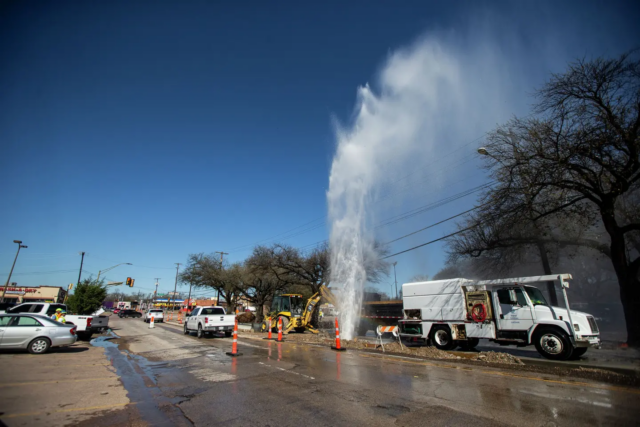
As then-council member Lee Simpson told the magazine, “We’ve put our infrastructure in the hands of high-quality professionals, and our citizens have little tolerance for failure. That’s why any weaknesses stand out.”
Repeatedly Wilson and TIME hailed Dallas Water Utilities’ use of cameras to inspect underground pipes. Which, true story, the city still does today: Just two years ago the council approved spending $5.59 million for “televised sewer inspection, maintenance, and repair services” through 2027. DWU officials told me that about 36% of the system is inspected with cameras annually.
But a memo sent to the City Council just four weeks ago warned, too, of an uptick in water loss: 10.36 billion gallons in 2025 alone, compared to 10.15 billion gallons reported in 2024 and about 10 billion gallons the year before.
That’s an 11.9% water loss, according to DWU officials, in part because of our lousy soil and weather — and, right, aging infrastructure. The memo says that despite ongoing investments and water-line replacements, the city will still need “additional contracted repair resources to supplement existing in-house capabilities.”
As for streets, Wilson wrote in 1980 that “there is a modest backlog of needed street resurfacing projects, but the city has reduced the mileage in
poor condition by upgrading many unimproved streets and resurfacing deteriorated pavements.” Forty-four years later, the Department of Public Works told the council it was $100 million short to make needed repairs, despite more than $500 million going toward transportation in the $1.25 billion 2024 bond program.
TIME said in 1981 that Dallas “executes its maintenance work with a precision similar to that of the Dallas Cowboys on a pass pattern.” Which maybe explains everything. But surely there’s another, longer book to be written about how we got from the Bright and Shiny 1980 to this moment defined by hiring freezes and furloughs; an inexplicable rush to abandon Dallas City Hall, which staff maintains needs hundreds of millions of dollars’ worth of fixes, for what’s likely an even older office tower; and a pizza party with the city manager if you throw out enough trash.
But one thing is remarkably clear: Just 46 years and 400,000 additional residents later, Dallas has become one of those sagging cities over which it once towered. All those small towns around us got big. And we just got old.
What works better or worse in Dallas now than in 1980?
A 1980 study from the Urban Institute hailed the city as a “municipal success story” that was once quick to fix everything.
Editorial Columnist
Robert Wilonsky is Dallas Morning News editorial columnist.