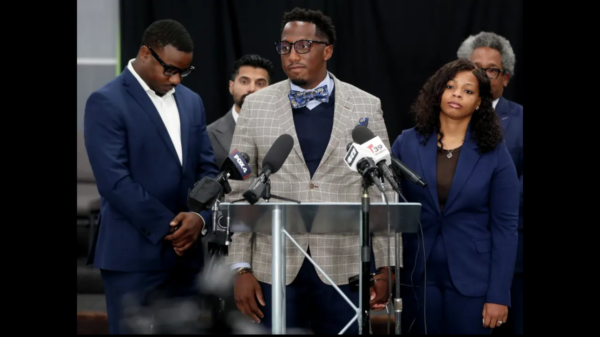
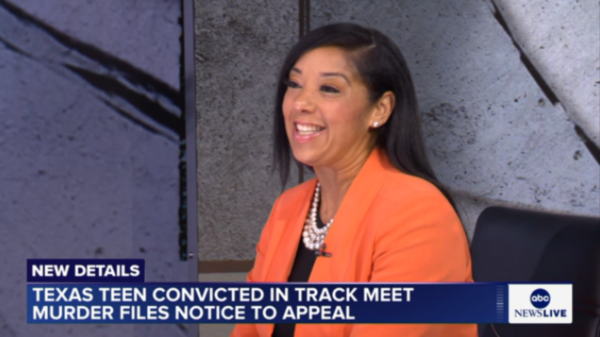
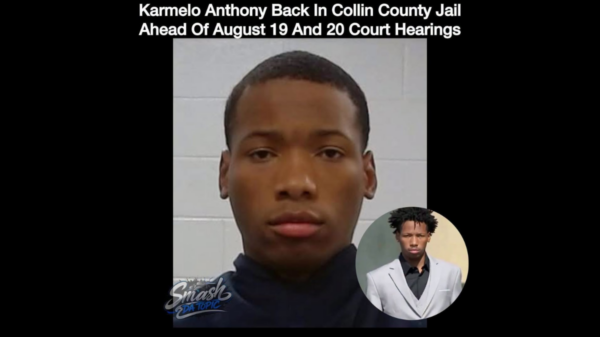
Anthony was convicted of killing 17-year-old Austin Metcalf last year at a Frisco track meet.
By Elissa Jorgensen, Sarah Bahari, Chase Rogers
Jurors found Karmelo Anthony, who fatally stabbed a teenager last year at a Frisco track meet, guilty of murder Tuesday afternoon.
The jury began deliberating Tuesday morning after closing arguments from prosecutors and attorneys for Anthony, who said he was defending himself when he stabbed 17-year-old Austin Metcalf. Anthony was also 17 at the time.
State district Judge John Roach Jr. told jurors they could also consider a lesser charge of manslaughter.
The case has drawn national attention from the start and generated a flood of misinformation and racist vitriol on social media. Anthony is Black. Metcalf was white.
Journalists from The Dallas Morning News will provide live updates throughout the day from the Collin County courthouse in McKinney.
From Monday: Defense rests case after Anthony not called to testify
Austin Metcalf’s family address the court — and Karmelo Anthony
After the jury was escorted from the courtroom, members of Austin Metcalf’s family delivered victim impact statements, a chance for those close to him to describe the toll of his death on their lives.
His mother, Meghan Metcalf, described a once-happy home filled with laughter that has grown quiet since her son’s death. She recalled hugging him on the morning of the track meet, unaware it would be the last time she would see him.
She said Anthony should feel lucky to have received 35 years because she had been “sentenced to a lifetime without my son.”
Anthony kept his head low for much of her remarks, appearing not to look toward her.
Austin Metcalf’s father, Jeff Metcalf, spoke next as a slideshow of photos from the twins’ childhood played in the courtroom. Birthday parties. Fishing trips. Football games.
“People think grief is sadness. It’s not — it’s rage,” he said, slamming his hands on the witness stand with enough force that some people in the courtroom jumped. “Pure, unfiltered rage. It’s trauma. It’s replaying every detail until you feel physically sick. It’s carrying images and memories your brain resets, but you can’t shut off.”
He described how his and Meghan Metcalf’s homes had been targeted by fake 911 calls meant to draw a large police response, and how narratives around the case had wrongly centered on race. “It made me realize how cruel people can be,” he said.
At one point, Jeff Metcalf asked Anthony to look at him as he spoke. Anthony did not appear to look up.
“You can’t even look me in the eye right now, but you can stab my f —- son in the heart,” he yelled, before apologizing to the judge.
Austin Metcalf’s twin brother, Hunter Metcalf, was the final family member to speak. He began by asking Anthony to look at him, saying he wanted a “little respect” but that he understood if Anthony could not do so.
Hunter Metcalf described the pain of losing his twin brother and how he had found some solace in his faith. He said he still did not understand why Anthony had taken so much from his family.
“Eventually, your name will be forgotten,” he told Anthony. “But my brother’s legacy will stay on.”
Anthony did not look up.
— Chase Rogers
Mostly peaceful crowd reacts to sentencing
After sentencing, emotions remained raw outside the Collin County courthouse as Karmelo Anthony’s family was escorted to a vehicle while supporters shouted words of encouragement.
As the vehicle pulled away, a family member of Anthony made a heart gesture from inside the car toward the supporters who were gathered outside.
The scene capped a tense afternoon outside the courthouse, where supporters on both sides of the case remained gathered after the verdict and sentencing. Sheriff’s deputies stepped in to diffuse a few tense standoffs between people in the crowd.
Deputies took two people from the scene in handcuffs after tensions flared. One of them was Sholdon Daniels, a Dallas-area attorney and former Republican congressional candidate who ran for the U.S. House District 30 seat held by U.S. Rep. Jasmine Crockett.
Justice Graham, an Anthony supporter who was outside the courthouse, said she was heartbroken by the 35-year sentence that was handed down.
“I feel like Karmelo did not intend to kill Austin,” Graham said, adding that she believed Anthony showed remorse and that the sentence was too severe. “When I heard 35 years, my heart broke because that could have been my brother. I’m sad. I’m upset.”
Graham also said she believed race shaped the public reaction to the case and the demonstrations outside the courthouse.
“Race has become a huge dynamic,” Graham said.
She said the arguments reflected the broader divide surrounding the case, criticizing some of the rhetoric she said she heard from counter protesters.
“They’re making it about race, too,” Graham said. “So what you’re going to get is different sides of the debate when it comes to race.”
The crowd slowly thinned after Anthony’s family left, though deputies remained outside the courthouse as small groups continued to gather.
— Michael Cuviello
D.A. Greg Willis thanks jury, judge
Collin County District Attorney Greg Willis addressed the news media as the Metcalf family stood by.
During his remarks, Willis highlighted the “strength and grace” of the Metcalf family and huggedAustin’s mother after reading a brief statement. He did not take questions.
Willis thanked the judge and the jury, saying that violence will not be tolerated in schools in Collin County.
“We remain committed to standing with schools and protecting victims and their families,” he said.
— Sally Avila Edwards
Court adjourns
District Judge John Roach Jr. adjourned the court at approximately 8:15 pm, closing out the eight-day trial. Metcalf’s aunt, mother, father and twin brother spoke during the victim impact statements after the sentencing.
Anthony sentenced to 35 years in prison
The jury sentenced Anthony to 35 years in prison and $0 in fines while rejecting the sudden passion defense introduced by Anthony’s attorney.
— Chase Rogers
Jurors begin deliberating sentence
Shortly before 7:30 p.m., the jury announced that it had reached a sentencing decision that is expected to be announced momentarily.
Collin County prosecutors stopped short of asking jurors to sentence Karmelo Anthony to a specific prison term, instead framing their decision as a reflection of the Frisco community’s moral standards.
“You are the conscience of this community,” Assistant District Attorney Bill Wirskye told jurors during closing arguments, urging them to impose a “lengthy” sentence that “dignifies” the loss felt by Austin Metcalf’s family and friends.
Defense attorney Mike Howard likewise did not suggest a specific sentence.
Instead, he asked jurors to consider “sudden passion,” a legal finding that could reduce Anthony’s punishment from the standard range for murder to that of a second-degree felony.
Howard emphasized Anthony’s age and the chaotic environment captured on surveillance footage, suggesting Anthony may have felt terror before stabbing Austin Metcalf.
“I am not asking you to do what I want, what they want, or what anybody wants,” Howard told jurors. “You have to follow your heart.”
He added that he wanted them to “consider both sides.”
Wirskye described the sudden passion argument as “completely inapplicable to this case and this set of facts.”
“They got it wrong,” he said of the defense’s strategy.
Once the sides were finished, district Judge John Roach Jr. directed jurors out of the courtroom to begin deliberating.
— Chase Rogers
Defense raises issue of ‘sudden passion’
Anthony’s defense has raised the issue of “sudden passion” during the trial’s punishment phase.
Under Texas law, sudden passion means emotion directly caused by provocation from the person killed — or someone acting with that person — arising at the time of the offense and not solely from earlier provocation. The provocation must amount to “adequate cause,” meaning it would commonly produce anger, rage, resentment or terror in a person of ordinary temper.
The burden is on the defense to prove sudden passion by a “preponderance of the evidence,” a lower standard than proof “beyond a reasonable doubt.”
If jurors find Anthony acted under the immediate influence of sudden passion arising from adequate cause, the murder conviction would be punished as a second-degree felony, carrying a sentence of two to 20 years in prison.
If they do not, Anthony faces the full punishment range for murder: five to 99 years or life in prison.
Both sides will have a final chance to address the jury Tuesday afternoon before deliberations begin on sentencing.
— Chase Rogers
Verbal fights, emotional reactions outside courthouse
Protesters clashed outside the courthouse while waiting for Anthony’s sentencing details. More than a dozen officers urged protesters to move away from the street and onto the sidewalk as verbal fights erupted.
Lori Arnold came to the courthouse to support the Metcalf family and said she was “disappointed” with the way people were acting.
As people waited for sentencing details, Metcalf and Anthony supporters continued to verbally clash across the parking lot of the courthouse. Dozens surrounded and filmed with their phones as one Anthony supporter yelled, “We should have won.”
Krystal Muhammad, who identified herself as the national chair of the New Black Panther Party for Self Defense, condemned the verdict, calling it racist and unfair.
“This was not a fair nor an impartial trial,” Muhammad said.
— Lola Jahant, Michael Cuviello, Sana Muneer
‘Healing and moving forward’
Texas state Rep. Jared Patterson, R-Frisco, said he considers the verdict justice served, calling Metcalf’s death “a senseless and heartbreaking tragedy” that forever changed his community.
“While no outcome can erase this pain, it is our hope that this moment allows the Metcalf family and our community to begin the difficult process of healing and moving forward together,” Patterson wrote Tuesday in a statement.
— Jamie Landers
Karmelo Anthony’s mother testifies
During the trial’s brief punishment phase, Anthony’s defense called one witness to the stand: his mother, Kala Hayes.
Hayes held back tears as she told jurors that although Anthony is her oldest child, he would always be her baby. Mike Howard, Anthony’s lead defense attorney, asked whether her son regretted what he had done.
“Yes,” she answered. “I know my son, and he’s very sorry for what he did.”
Howard then asked whether there was anything she wanted the jury to consider.
“Please have mercy on my son,” she said.
Anthony sobbed softly as his mother spoke from the stand.
After the defense passed the witness, Assistant District Attorney Bill Wirskye asked Hayes whether she understood she would still be able to be part of her son’s life after he went to prison.
“Yes, I do,” she responded.
Jurors were sent out of the courtroom while attorneys worked on the jury charge — the framework that will guide their deliberations. Once a draft was in hand, District Judge John Roach Jr. said he would hold a hearing to discuss it.
Anthony faces up to life in prison.
— Chase Rogers
Emotions run high outside courthouse
Emotions spilled outside the courthouse, where supporters on both sides argued in several tense verbal exchanges.
At one point, a person holding a baby exchanged words with a Karmelo Anthony supporter as others in the crowd shouted over one another. Deputies stepped in and broke up the confrontation.
Ken McCain, who was outside the courthouse after the verdict, said he believed the case reflected broader failures by adults and society, not just the actions of the two teenagers involved.
“I hate that one young man is going to be lost to the system, and one young man lost his life,” McCain said. “We need to teach our children that it’s OK to walk away.”
Krystal Muhammad, who identified herself as the national chair of the New Black Panther Party for Self-Defense, condemned the verdict and said Anthony was not judged by his peers. No Black members were seated on the jury, which some in the community called unfair.
“He did not have a jury of his peers from his same social and economic group,” Muhammad said.
— Michael Cuviello
Sentencing phase
Prosecutors and defense attorneys wrapped up a brief sentencing phase, and jurors returned to deliberate the sentence for Karmelo Anthony. He faces five years to life in prison.
As people waited for new details, verbal fights between Austin Metcalf and Anthony supporters erupted in the parking lot outside the courthouse. Dozens surrounded and filmed with their phones as a supporter yelled “we should have won.”
Jury finds Karmelo Anthony guilty
Karmelo Anthony committed murder when he fatally stabbed 17-year-old Austin Metcalf last year during a confrontation at a high school track meet, a jury decided Tuesday.
The guilty verdict came after three hours of deliberation at the end of a closely watched trial in Collin County. The case has attracted national attention from the start and fueled months of racist vitriol on social media.
Defense attorney Mike Howard wrapped one arm around Anthony as the verdict was read. Anthony stood with his eyes lowered.
Arguments erupted outside the courthouse as news of the verdict spread. Police urged the crowd to move away from the street and onto the sidewalk.
— Chase Rogers and Lola Jahant
Jurors in Karmelo Anthony’s murder trial reached a verdict Tuesday afternoon, the court-appointed public information officer said about 1:45 p.m. They deliberated for nearly three hours.
Families, media members and court watchers were directed back to the courtroom, where the jury’s decision is expected to be announced shortly.
When news of a verdict spread, the crowd outside the courthouse surged forward. “What do we want? Justice.” they chanted, hoisting posters and pumping their fists.
— Chase Rogers
The defense argument
Karmelo Anthony said he was defending himself when he fatally stabbed Austin Metcalf. How does that claim work in a trial?
To successfully argue self-defense in Texas, a defendant must reasonably believe the force they used was necessary to protect them from serious bodily injury or death. As in all criminal trials, prosecutors have the burden of proving the charge beyond a reasonable doubt. Even in self defense, that burden of proof remains with the prosecution. A person claiming self-defense can’t be the aggressor or engaged in criminal activity at the time.
“A key consideration in self-defense cases is what would an ordinary, prudent person in the same situation do,” Dallas criminal defense attorney Nigel Redmond said. “Would they do the same thing you did if they faced the same threat?”
Crowd grows outside courthouse
The crowd outside the courthouse is growing as the jury deliberates inside. Television crews set up equipment as others bowed their heads in prayer circles and found shade beneath trees.
The case has ignited sharp divisions and drawn demonstrators on both sides since the trial began June 1.
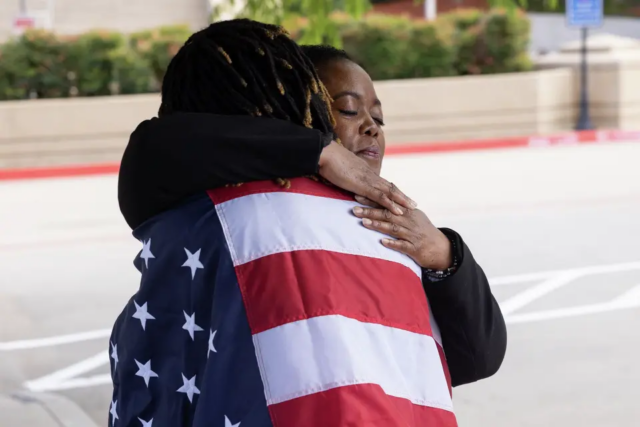
“I just felt that we all needed a little bit more prayer, a little bit more understanding, a little bit more clarity and a little bit more love,” said Jasmine Noelle, who wore a traditional African dress and draped herself in an American flag.
— Sana Muneer and Lola Jahant
State’s closing argument
During the state’s closing argument, Assistant District Attorney Bill Wirskye disputed the defense’s claims and asked jurors to focus, in part, on Anthony’s apparent mindset when he decided to bring a knife to the track meet.
Wirskye said Anthony’s decision to bring the knife, his refusal to leave the tent, the surveillance footage and the witness testimony were enough for a murder conviction. He argued Anthony provoked Austin Metcalf into pushing him — a finding that, if jurors agree, would bar Anthony from claiming self-defense under the jury charge.
“You don’t get to meet a shove with a stab, especially if you provoked the shove,” Wirskye told jurors.
Wirskye also acknowledged inconsistencies in the students’ earlier testimony, saying such discrepancies are common in trials. But he argued those differences were ultimately inconsequential because the witnesses were aligned on one key point: Anthony was not acting in self-defense.
Wirskye dismissed the defense’s theory that Metcalf impaled himself on Anthony’s knife as “ludicrous,” but urged jurors to return a verdict of manslaughter if they believed it had merit. When the state finished, jurors were directed out of the courtroom to begin deliberating.
Jeff Metcalf, Austin Metcalf’s father, kept his head down for much of the defense’s closing arguments, but lifted his eyes toward the state’s closing.
— Chase Rogers
Jurors can consider manslaughter
Jurors can consider manslaughter in addition to the murder charge against Karmelo Anthony, District Judge John Roach Jr. said Tuesday as he read the instructions to the jury.
If convicted of murder, Anthony could face five years to life in prison. But manslaughter, a lesser charge, carries a sentence of two to 20 years.
Closing arguments have wrapped up, with each side allotted 35 minutes to make their final case. Collin County District Attorney Bill Wirskye waived the state’s right to go first.
Anthony’s lead defense attorney, Mike Howard, began his closing argument by challenging the state’s portrayal of the case, arguing that Austin Metcalf did not have the legal authority to “put his hands on” Anthony.
“A hit, a shove, a push,” Howard told jurors, “’Melo had an absolute right to defend himself from that.”
Howard revisited the Collin County medical examiner’s testimony in closing. He used a highlighter to demonstrate the possible angle of the knife wound on Metcalf, describing it as “awkward.”
He argued that an intentional, aggressive stabbing motion would have produced a different wound, suggesting instead that the wound was consistent with a hasty action taken in self-defense.
— Chase Rogers
Anthony supporters at courthouse
Supporters of Karmelo Anthony brought three large wooden signs, each about four feet long and two feet tall, to the courthouse. Using drills to fasten the sign to yard sticks, they propped up the signs to stand in the protest area.
One of the signs read “united we stand, divided we fall.” Another said, “Self defense is not a crime Karmelo Anthony should do no time.” The third read, “Hands off Karmelo Anthony, let the truth be heard.”
— Lola Jahant
‘Free hugs and prayers’
Shortly before 9 a.m., Lorenzo Henry stood outside the courthouse and raised a shofar horn to his lips. Blowing into it, a distinct note emanated through the curved mouthpiece, directly toward the courthouse.
“It’s like bringing a doorbell to heaven, basically calling the armies of God, the angels,” Henry said of the horn’s sound. “Let them gather up around this place because that’s what we need right now.”
Henry, a pastor at Kingdom Application Ministries in McKinney, has stood outside the courthouse every Thursday for six months. He has stood there for several days of the Karmelo Anthony trial, which began June 1, praying for both the Metcalf and Anthony families.
“For the Metcalf family, my heart goes out to them,” Henry said. “Also for the Anthony family, my heart goes out to them, because they’ve been going through this for a whole year waiting on this to happen, and now they’re looking at losing their son in the process.”
His arms raised above his head, Henry swayed to gospel music flowing from a speaker, which was next to a sign that read “Free Hugs & Prayers.”
“No one should be losing children at such a young age, being dead or in the system,” Henry said. “Nothing good can come from this that I see except God do something about it. And so we’re gonna let God be God and just pray that he intervenes like he’s never done before.”
— Sana Muneer
Outside the courthouse
A handful of Karmelo Anthony supporters, all dressed in purple, gathered beneath blue tents Tuesday morning outside the courthouse in McKinney. Hand-drawn signs, decorated with colorful handprints and hearts, lined the entry way. Other signs read “hands off” and “Self defense is not a crime.”
— Lola Jahant and Sana Muneer
Closing arguments
Closing arguments are slated to begin shortly. These give prosecutors and defense attorneys a final chance to summarize the evidence and tell jurors how they believe it should be interpreted. Their remarks are not evidence, but they can shape how jurors weigh testimony, exhibits and the legal instructions before deliberations begin.
Karmelo Anthony trial, an overview
Here’s a look back at the high-profile trial for those catching up.
The trial began June 1 with 600 Collin County residents called to jury duty. For comparison, that’s twice the number of people who were summoned for the Tanner Horner death penalty case in Tarrant County, which also received substantial publicity.
State District Judge John Roach Jr. pared down the pool to the 12-person jury on June 3. Defense attorneys accused prosecutors of striking three Black jurors — the only three Black candidates left in the jury pool — without proper cause. Prosecutors are required to provide a “race-neutral” reason for striking the jurors, and they said it was because all three were educators. The judge sided with prosecutors.
Both sides laid out their cases during opening arguments June 4. Prosecutors argued Anthony provoked the confrontation, seizing on brief physical contact as an excuse to commit murder. Anthony’s defense attorneys argued he made a split-second decision in the face of a threat from teenagers larger than him — an act they say amounted to self-defense.
Witnesses, many of whom are minors, have described the conflict that led to the stabbing and chaotic aftermath. Jurors got their first glimpse of the pocketknife prosecutors say Anthony used to fatally stab Austin Metcalf.
Four students called by the state who saw the confrontation differed on some details, but all agreed on one point. Anthony was the aggressor. The prosecution rested its case Saturday.
On Monday, attention turned to the defense, which called several witnesses, including Anthony’s coach, who said athletes commonly shared tents during track meets. Anthony did not testify in his defense.
What happened Monday during the trial?
The jury heard testimony from two students and a Frisco police officer.
A 17-year-old Centennial High School student called to testify Monday didn’t witness the stabbing itself, but said he later saw Anthony crying on the track while being comforted by a coach.
During direct examination by lead defense attorney Mike Howard, the student told jurors he was warming up on the field when he noticed a shift in demeanor among athletes gathered under Frisco Memorial’s tent. He testified that he saw what appeared to be a shove, describing a boy — later identified as Metcalf — extending both arms and making contact with Anthony.
Prosecutors challenged the narrative during cross-examination, using surveillance video to demonstrate that parts of his recollection didn’t match the timeline captured on camera.
Related: Behind the gavel: A look into the veteran judge overseeing the Karmelo Anthony trial
Another Frisco student, 17, testified that he saw several people standing around Metcalf and Anthony when the altercation occurred.
“All of a sudden, I saw someone get pushed or punched,” he told lead defense attorney Mike Howard on the stand, adding that he saw the student who was struck make a swinging motion with his arm.
During cross-examination, prosecutor Bill Wirskye again challenged the recollection, citing video evidence which he said showed a different version of events than what the student previously said in his police statement.
After the students testified, Frisco police officer Beau Riley was briefly questioned. Defense attorneys appeared to suggest that a student under Frisco Memorial’s tent may have recorded part of the altercation between Metcalf and Anthony. But the line of questioning ended without establishing whether any such video exists.
Judge Roach then excused the jury for an early lunch break. Court was expected to resume at 12:30 p.m, though it remained closed to the public and media until about 2:20 p.m.
Once court resumed, Roach said closing arguments would begin at 9 a.m. Tuesday and that he would allow the jury to deliberate as long as they want. If the jurors call it a day without reaching a decision, they will be sequestered in a hotel, without their phones, until they return to the courthouse, he said.
“We’re getting close, I’m telling ya,” Roach told jurors before dismissing shortly before 2:30 p.m.
— Jamie Landers
Why death penalty is not a possibility
On social media, some have called for Anthony to receive the death penalty. That’s not on the table, though. Here’s why.
Anthony, like Austin Metcalf, was 17 at the time of the stabbing. The U.S. Supreme Court ruled in 2005 that executing anyone for a crime committed while under the age of 18 constitutes “cruel and unusual punishment,” making Anthony ineligible for a death sentence under federal law.
If convicted, Anthony faces five years to life in prison.
Related: No, Karmelo Anthony will not get the death penalty for the Frisco stabbing. Here’s why
— Jamie Landers
Is the Karmelo Anthony trial televised?
District Judge John Roach Jr. imposed strict rules for the trial, including banning cameras from the courtroom. The Collin County courthouse rules also prohibit cameras throughout the building.
In a court order, Roach said the case has “generated substantial public and media attention and that unrestricted access or activity may compromise courtroom security, juror privacy, and the Defendant’s right to fair trial.”
Related: Will the Karmelo Anthony trial be televised? The News has answers on how to get live updates
Other rules in place, according to the order:
- Attendees must remain silent and respectful while in the courtroom.
- Gestures, facial expressions or other reactions to testimony or court rulings are not permitted.
- Clothing or other items displaying messages, logos, symbols or images related to the case or that are considered to be distracting or potentially prejudicial are prohibited.
- Signs, banners or other such materials also are not allowed in the courthouse.
— Jane Harper and Lana Ferguson
Elissa Jorgensen is a breaking news reporter at The Dallas Morning News. She is a graduate of Texas State University, where she earned her bachelor’s degree in English and master’s degree in mass communication. Elissa previously reported for the Houston Chronicle and Texas Community Health News.
Sarah Bahari is a trending news reporter. She previously worked as a writer for the Fort Worth Star-Telegram, where she covered a bit of everything. She is a graduate of Kansas State University.
Chase Rogers covers the Dallas Police Department, Dallas Fire-Rescue, and broader public safety issues in Dallas. He grew up in Granbury and studied journalism at Texas State University in San Marcos. Before joining The News, he reported for the Austin American-Statesman and the Corpus Christi Caller-Times. His work has earned investigative reporting and Freedom of Information awards, including Texas Managing Editor’s Star Reporter of the Year in 2022. He can be reached at 361-239-6527 and on Signal at crogers.95.