By Sarah Bahari
Staff writer
Dallas Morning News
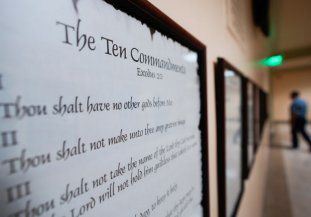
1 in Texas, including a law requiring public
schools display the Ten Commandments in
each classroom. Photo: John Bazemore / AP
A slate of new laws will go into effect Monday in Texas.
State legislators passed hundreds of new laws during the recently concluded regular session, from a ban on cellphones in schools to new labels for foods that contain certain dyes and additives. Legislators are now meeting in a special session to consider redistricting and ways to help Central Texas flood victims, so additional laws are likely.
Cellphone ban. A new law prohibits students from using cellphones and other personal electronic devices at school. Texas school districts will have 90 days to adopt and enforce new policies on how cellphones will be restricted or stored on campus. State leaders say the new law is meant to reduce distractions in the classroom and improve academic performance and student well-being.
Ten Commandments. Public schools will be required to display a poster or framed copy of the Ten Commandments in each classroom. Displays must be at least 16 by 20 inches. The law has already sparked a flurry of legal challenges from groups who say it is unconstitutional, and a federal judge issued a temporary block.
Prayer in schools. Public school districts can adopt policies requiring campuses to set aside time for students and staff to pray or read a religious text. Opponents argued the law crosses a line between church and state and encroaches on religious freedom.
DEI and student clubs. School-sponsored LGBTQ clubs are prohibited under Senate Bill 12, which bans student organizations based on sexual orientation or gender identity. The law also bans diversity, equity, and inclusion policies and programs in public K-12 schools. Legislators already banned DEI in public universities and colleges in 2023. The law is facing legal challenges from groups who argue it violates freedom of speech.
Financial literacy. Texas high school students will be required to take at least one semester of personal financial literacy starting in the 2026-2027 school year.
Money
Property taxes. Legislators slashed property taxes for homeowners with a couple of constitutional amendments. One raises the homestead exemption from $100,000 to $140,000; the other would raise the exemption to $200,000 for state residents with disabilities or those 65 and older. The average homeowner would save about $500 in taxes per year when combined with the lower school district taxes in the state budget, elected leaders say. Voters must approve the amendments in November.
Business taxes. A new law increases the personal property tax exemption for businesses from $2,500 to $125,000. Voters must approve the amendment in November.
Texas lottery. Under this law, the state will dissolve the Texas Lottery Commission and transfer the agency’s responsibilities to the Texas Department of Licensing and Regulation. The law, which went into effect also bans the sale of lottery tickets online or through third-party courier apps. The law comes as state officials are investigating two controversial jackpots. In one of the jackpots awarded in 2023, an overseas entity won $95 million by buying over 25 million $1 tickets, giving it access to almost every possible number combination.
Evictions. Tenants across Texas could face expedited evictions as part of a new law billed as a solution to the issue of “squatting” — or occupying a property without legal permission. The law expedites evictions and, according to some advocates, limits tenant due process because a judge can rule in the landlord’s favor without a hearing. It will take effect Jan. 1, 2026.
Sex and health
Food labels. Foods and drinks sold in Texas that contain certain dyes and additives deemed “not recommended for human consumption” will require warning labels. The law received bipartisan support but pushback from the food industry. Manufacturers have some time to implement this. The law applies to food labels developed or copyrighted on or after Jan. 1, 2027.
Abortion. Senate Bill 31 clarifies that doctors are not required to delay or withhold lifesaving medical treatment for a woman to try to preserve a fetus. It also says physicians and attorneys can talk with a patient about a medically necessary abortion without running afoul of the law. Critics say the law does not do enough to protect women facing pregnancy-related medical emergencies. The law went into effect upon the governor’s signing June 20.
Sex dolls. A new law will make it a criminal offense to own childlike sex dolls. Owning such a doll is now classified as a state jail felony, and possessing one with the intent to promote it is a third-degree felony. Lawmakers say the law aims to bar materials that simulate or normalize child exploitation. The law also establishes a limit of two sex dolls per person.
Definitions of a man and woman. The state has established legal definitions of sex and gender. House Bill 229 defines a woman as “an individual whose biological reproductive system is developed to produce ova,” and a man as “an individual whose biological reproductive system is developed to fertilize the ova of a female.” The law will help strengthen the state’s effort to block changes to gender markers on state documents, such as birth certificates and driver’s licenses.
IV therapy. This new law requires physicians to supervise or delegate elective intravenous (IV) therapy to registered nurses, advanced practice registered nurses or physician assistants. Known as “Jenifer’s Law,” the law comes after the death of Jenifer Cleveland, who died while receiving an IV therapy infusion in 2023 in Wortham, about 70 miles south of Dallas.
Psychiatric help. Under a new law, officers can detain someone with anosognosia, or the inability to recognize one’s psychiatric condition, for evaluation by a mental health professional. The law was hailed by some who say it will help people receive treatment, but others have worried about potential infringement on civil liberties.
Technology
Children and apps. The Texas App Store Accountability Act requires app stores to verify users’ ages and obtain parental consent before minors can download or purchase an app. The bill drew bipartisan support, but app store operators Google and Apple opposed the law, arguing that it undermines privacy. Operators will have a little more time to implement this law, which goes into effect Jan. 1, 2026.
Sexual images of children. A new law bans the possession of obscene images and other visual material that appears to depict minors — including computer-generated material and AI, cartoons, and animation that depict artificially created child characters or depict an actual child. Violations would be a state jail felony punishable by up to two years in prison and a $10,000 fine, with harsher penalties available for repeat offenders.
Lab-grown meat. Lawmakers approved a ban on lab-grown meat sales for the next two years. Although cultured meat, which is produced by growing cells acquired from living animals, is not common yet, some worry it could disrupt the livestock industry. Texas was the seventh state to enact some sort of ban on lab-grown meat.
Law enforcement, criminal justice
Road rage shootings. A new law will make road rage shooting a first-degree felony, punishable by five years to life in prison. Previously, penalties varied. The law comes after a spate of fatal road rage shootings across Texas.
Safety in retirement communities. This bipartisan law aims to improve safety in senior retirement communities. All retirement communities will be required to conduct employee background checks, establish policies to share information about nearby criminal activity and bar communities from limiting communication with law enforcement, social workers and family members. The law is in response to Billy Chemirmir, who was convicted of killing about two dozen elderly women in Dallas and Collin counties.
Intoxication manslaughter for undocumented immigrants. Greyson’s Law increases the mandatory minimum sentence for intoxication manslaughter from two to 10 years if the defendant did not have legal status in the U.S. The law is named after Grayson Davis, killed in a 2024 crash in Bastrop County by an alleged drunk driver.
Non-disclosure agreements. A new law commonly referred to as Trey’s Law bans the use of nondisclosure agreements to silence victims of sexual abuse. The law is named after Trey Carlock, a Dallas native who was abused as a child and later died by suicide after being required to sign an NDA as part of a settlement. Lawmakers championed the law in the wake of prominent church sex abuse scandals.
Short-barrel firearms. Under this law, owning short-barrel firearms will be legal in Texas. Short-barrel firearms are rifles with barrels shorter than 16 inches and shotguns with barrels shorter than 18 inches. Opponents of the bill argued it is easier to conceal short-barrel firearms because of their smaller size. A short-barrel shotgun was used in a 2018 school shooting in Santa Fe, Texas, that left eight students and two teachers dead.
This story, originally published in The Dallas Morning News, is reprinted as part of a collaborative partnership between The Dallas Morning News and Texas Metro News. The partnership seeks to boost coverage of Dallas’ communities of color, particularly in southern Dallas.