Without an agreement, global supply chains could face renewed turmoil from duties exceeding 100%.
By Reuters
Dallas Morning News
https://www.dallasnews.com/
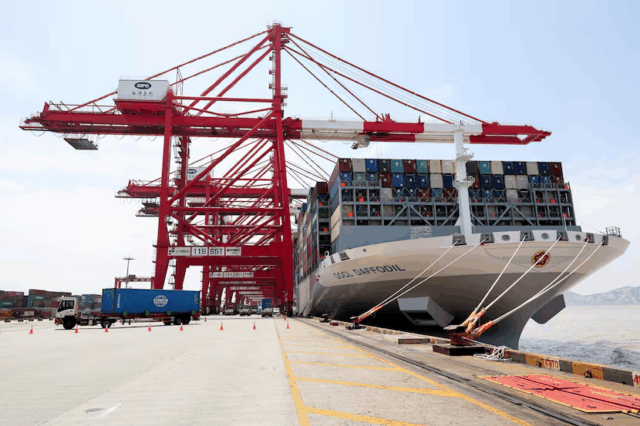
STOCKHOLM — Senior U.S. and Chinese negotiators will meet in Stockholm on Monday to tackle longstanding economic disputes at the center of the countries’ trade war, aiming to extend a truce keeping sharply higher tariffs at bay.
China is facing an Aug. 12 deadline to reach a durable tariff agreement with President Donald Trump’s administration, after Beijing and Washington reached a preliminary deal in June to end weeks of escalating tit-for-tat tariffs.
Without an agreement, global supply chains could face renewed turmoil from duties exceeding 100%.
The Stockholm talks, led by U.S. Treasury Secretary Scott Bessent and Chinese Vice Premier He Lifeng, take place a day after European Commission President Ursula von der Leyen met with Trump at his golf course in Scotland and reached a deal that set a 15% baseline tariff on most EU goods.
Trade analysts on both sides of the Pacific say the discussions in the Swedish capital are unlikely to produce any breakthroughs but could prevent further escalation and help create conditions for Trump and Chinese President Xi Jinping to meet later this year.
Previous U.S.-China trade talks in Geneva and London in May and June focused on bringing U.S. and Chinese retaliatory tariffs down from triple-digit levels and restoring the flow of rare earth minerals halted by China and Nvidia H20 AI chips and other goods halted by the United States.
So far, the talks have not delved into broader economic issues. They include U.S. complaints that China’s state-led, export-driven model is flooding world markets with cheap goods, and Beijing’s complaints that U.S. national security export controls on tech goods seek to stunt Chinese growth.
“Stockholm will be the first meaningful round of U.S.-China trade talks,” said Bo Zhengyuan, Shanghai-based partner at China consultancy firm Plenum.
Deals, deals, deals
Trump has been successful in pressuring some other trading partners, including Japan, Vietnam and the Philippines, into deals accepting higher U.S. tariffs of 15% to 20%.
He said there was a 50-50 chance that the U.S. and the 27-member European Union could also reach a framework trade pact, adding that Brussels wanted to “make a deal very badly”.
Two of Trump’s top trade officials, Commerce Secretary Howard Lutnick and U.S. Trade Representative Jamieson Greer, will attend the Scotland talks and then travel to Stockholm.
Analysts say the U.S.-China negotiations are far more complex and will require more time. China’s grip on the global market for rare earth minerals and magnets, used in everything from military hardware to car windshield wiper motors, has proved to be an effective leverage point on U.S. industries.
Trump-Xi meeting?
In the background of the talks is speculation about a possible meeting between Trump and Xi in late October.
Trump has said he will decide soon whether to visit China in a landmark trip to address trade and security tensions. A new flare-up of tariffs and export controls would likely derail any plans for a meeting with Xi.
“The Stockholm meeting is an opportunity to start laying the groundwork for a Trump visit to China,” said Wendy Cutler, vice president at the Asia Society Policy Institute.
Bessent has already said he wants to work out an extension of the Aug. 12 deadline to prevent tariffs snapping back to 145% on the U.S. side and 125% on the Chinese side.
Still, China will likely request a reduction of multi-layered U.S. tariffs totaling 55% on most goods and further easing of U.S. high-tech export controls, analysts said. Beijing has argued that such purchases would help reduce the U.S. trade deficit with China, which reached $295.5 billion in 2024.
China is currently facing a 20% tariff related to the U.S. fentanyl crisis, a 10% reciprocal tariff, and 25% duties on most industrial goods imposed during Trump’s first term.
Bessent has also said he would discuss with He the need for China to rebalance its economy away from exports toward domestic consumer demand. The shift would require China to put an end to a protracted property crisis and boost social safety nets to encourage household spending.
Michael Froman, a former U.S. trade representative during Barack Obama’s administration, said such a shift has been a goal of U.S. policymakers for two decades.
“Can we effectively use tariffs to get China to fundamentally change their economic strategy? That remains to be seen,” said Froman, now president of the Council on Foreign Relations think-tank.
(Reporting by David Lawder; Additional reporting by Laurie Chen in Beijijng; Editing by Helen Popper / Reuters News Agency)
This story, originally published in The Dallas Morning News, is reprinted as part of a collaborative partnership between The Dallas Morning News and Texas Metro News. The partnership seeks to boost coverage of Dallas’ communities of color, particularly in southern Dallas.