Roach oversaw Anthony’s murder trial in June, when a jury convicted the 19-year-old of fatally stabbing Austin Metcalf at a high school track meet.
By Jamie Landers, Sally Avila Edwards,Staff Writer
McKINNEY — The judge who oversaw Karmelo Anthony’s murder trial was removed Wednesday from continuing on the case, a rare move that leaves a newly assigned judge to decide whether the Frisco teen should be granted a new trial.
District Judge John Roach Jr. was recused following an hourlong hearing at the Collin County courthouse in McKinney. Roach presided over Anthony’s trial in June, when a jury convicted the 19-year-old of fatally stabbing Austin Metcalf at a high school track meet and sentenced him to 35 years in prison.
Retired Judge Michael Chitty was appointed to take Roach’s place. Chitty will take the bench Thursday morning, when Anthony’s defense team is expected to bid for a chance to retry the case.
Judge Sid Harle, an administrative judge from San Antonio, presided over Wednesday’s recusal hearing. Harle said while he personally believed Roach could rule fairly on Anthony’s motion for a new trial, he stated that was “not the test” to determine whether Roach would be pulled from the case.
Harle explained the decision was to be made from the perspective of an outside party: “a reasonable member of the public.” It was from that point of view, Harle said, that he agreed to grant the recusal.
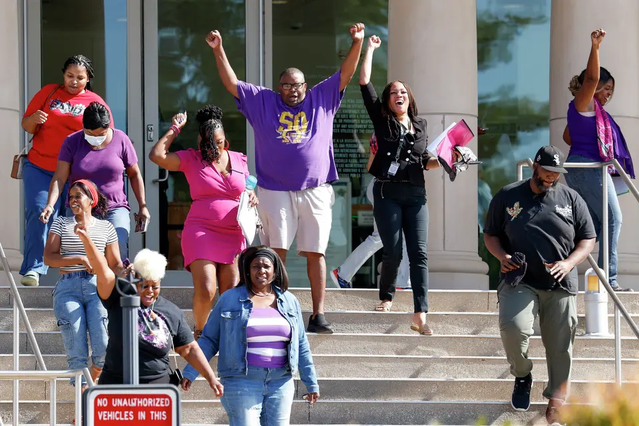
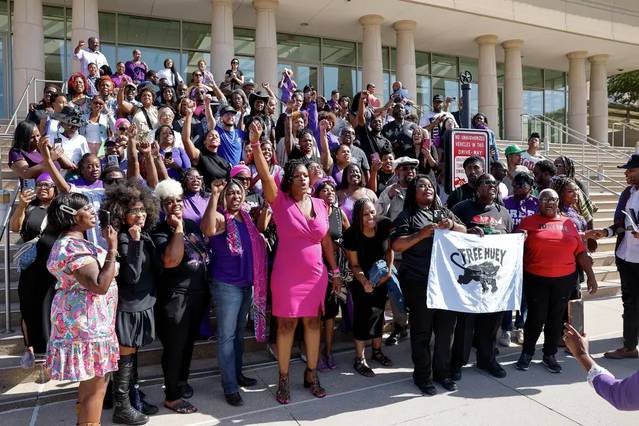
Outside the courtroom, dozens of spectators cheered, some lifting their fists to celebrate the news. A handful of people gathered at a median, chanting “Karmelo!” and “Bring him out!”
“They heard us,” one man said, as he hugged a friend.
David Prall, Metcalf’s grandfather, declined to comment on the recusal. He previously told The Dallas Morning News his family maintains their belief that the trial was fair.
“Twelve people convicted him,” Prall said then. “That’s our justice system.”
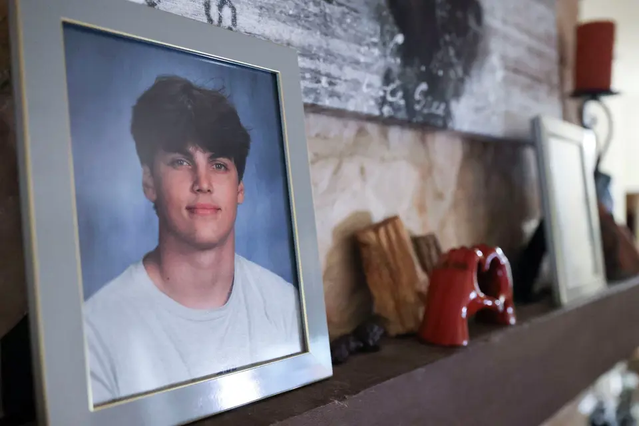
Metcalf, 17, was a junior at Frisco Memorial High School. He was a gifted football player, his father said last year in an interview, earning the title of all-district linebacker and Centennial’s MVP. He hoped to one day play college ball.
Anthony appears for hearing
When Anthony’s appellate team arrived about 8:30 a.m., a crowd of more than two dozen people seated outside the courtroom started to cheer. In ties, dresses, sneakers and bracelets, the supporters sported shades of purple — Anthony’s favorite color.
Anthony was seated in the courtroom shortly after 9 a.m. next to his attorney, Mike Ware. He was wearing a dark green, short-sleeve jumpsuit, his head shaved. His wrists were chained in front of him, secured to his waist.
Before the hearing began, Russell Wilson, Anthony’s lead counsel and former Dallas County prosecutor, asked Harle if Anthony’s restraints could be removed. Harle granted the request.
Anthony’s legal team pointed to an interview Roach sat for just days after Anthony’s trial ended as evidence that Roach’s impartiality was compromised — a strategy that ultimately proved effective.
Wilson began by playing an 18-minute, unedited audio clip of an interview Roach gave a WFAA reporter shortly after the trial, a conversation cited in the motion to recuse. The interview spanned several topics, including efforts to protect jurors and witnesses, the decision not to have cameras inside the courtroom and the toll of social media vitriol on the case.
“Did the jury get it right?” the reporter asked.
“They did,” Roach said. “They listened to the facts … and they got a verdict. Whatever they say, they get it right.”
“What’s your take on Karmelo Anthony?” the reporter asked shortly after.
“He seems like a nice young man who committed a crime, and he understands today, more than any day before, the consequences of committing a crime like he did,” Roach said.
Wilson cited Canon 3B(10) of the judicial code, which states a judge must abstain from public comment about pending or impending proceedings. Pointing to the WFAA interview, Wilson said Roach’s commentary was not only directly related to the motion for a new trial, but was given after Anthony had already notified the court he would be appealing his conviction.
“He has publicly declared a judgment on the very things sought to be resolved,” Wilson told the court.
In a brief filed before the hearings, Anthony’s attorneys also noted three other occasions that raised concerns about Roach’s impartiality: a written statement he made to Fox News; a gag order he instated barring those involved in the trial from speaking about it publicly; and a June 17 letter he addressed to “members of the Collin County family.”
In the letter, Roach, who is retiring at the end of the year, wrote that presiding over the trial was “one of the great honors of [his] judicial career” and that he believed it was handled fairly.
Roach declined to comment on the recusal hearing and his various public statements since the trial when reached via email by The News.
Collin County prosecutor Bill Wirskye, who tried Anthony’s case, told the court Wednesday he remained unsure if the state should have been a party to the hearing: “I don’t know if it’s our job to defend Judge Roach or not,” he said.
Wirskye told the court both parties — the state and the defense — agreed to the rules Roach set in place to “protect the integrity of the trial.” He homed in on the defense, citing Roach’s letter to Collin County in its appeal, stating gratitude does not compromise a judge’s ability to be fair.
“It’s too bitter a pill to swallow, your honor,” Wirskye said. “From where we sit, those of us who lived it, he didn’t do anything wrong.”
Questions over public access
Beyond impartiality, the defense also focused on the public’s access to the courtroom. Wilson characterized the court’s earlier decision to remove the trial’s overflow room — without putting a formal notice on the record — as a “structural error.”
Wilson pushed back against the notion that physical attendance in the courthouse served as an adequate substitute for the removed digital access. Wilson argued that the Sixth Amendment guarantees an actual opportunity for the public to attend, rather than forcing citizens to rely on a “first-come, first-served” lottery by waiting in line.
“We believe we have shown, overwhelmingly, that Judge Roach should be recused,” Wilson said.
Unlike June’s trial, attendees at Wednesday’s hearing had access to an overflow room, where the proceedings were streamed. The hearing, like the trial, was open to the public, but those hoping for a limited set of seats inside were handed numbered business cards when they arrived. A limited number of individuals were granted access to the courtroom, with the others filed into the overflow room.
A sparse crowd, largely media, gathered outside the courthouse Wednesday morning. It was a stark change from Anthony’s trial in June, when dozens of demonstrators for the Metcalf and Anthony families argued over the proceedings.
Next steps
With the next phase of Anthony’s case slated for Thursday, Chitty will need to move quickly to coordinate the hearing for a new trial.
Chitty, a former senior judge from Kaufman County, was tapped by Presiding Judge Ray Wheless in late July to take over Anthony’s case, should Roach be recused.
Anthony’s case is under a tight deadline: Texas law gives the court 75 days to rule on a motion for a new trial after the defendant is sentenced. For Anthony, that deadline falls on Aug. 24. If the court doesn’t act by then, the motion is automatically denied.
Staff writer Nicole Asbury contributed to this report.
Senior Breaking News Reporter
Jamie Landers is the senior breaking news reporter at The Dallas Morning News, where she covers crime, courts and capital punishment. She is a graduate of The Walter Cronkite School of Journalism and Mass Communication in Phoenix, where she studied journalism and political science. Jamie previously reported for The Arizona Republic and Arizona PBS.
Staff writer
Sally Avila Edwards is an intern for The Dallas Morning News. Avila Edwards covers the latest breaking and trending news about the Dallas-Fort Worth area. She graduated from Harvard with a degree in Government and English Literature. Originally from Central Texas, Avila Edwards previously reported for KXAN Austin and The Harvard Crimson.