District records show teacher resignations spiked after new state-appointed leaders arrived.
By: Silas Allen
Dallas Morning News
https://www.dallasnews.com/

Nearly 800 teachers in Fort Worth ISD submitted their resignations in the three months after the arrival of the district’s state-appointed leadership — more than in the entire previous school year.
The second-largest district in North Texas is under a state takeover after more than a decade of stagnant academic progress. When incoming Superintendent Peter Licata arrived in the district in March, he pledged that the takeover would mean good things for “excellent teachers,” including better pay, dynamic leadership and the opportunity to be a part of meaningful efforts to turn struggling schools around.
But since then, Fort Worth ISD has seen a sharp surge in the number of teachers leaving the district, records show. Departing teachers cited chaotic leadership, intense micromanagement and difficult working conditions as factors in their decision to leave.
Fort Worth ISD teachers hit the exits after takeover
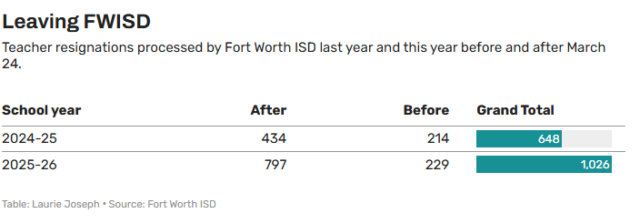
Texas Education Commissioner Mike Morath announced a takeover of Fort Worth ISD last year after one campus received five consecutive F ratings. By the end of the school year, the district had seen a marked uptick in teacher departures. Fort Worth ISD received 1,026 resignations from teachers by June 28, which was the district’s deadline for employees to resign, according to district data released in response to a Dallas Morning News public records request. That’s up from 648 teacher resignations by last year’s deadline, an increase of roughly 58%.
But the surge in teacher resignations didn’t begin in earnest until after TEA officials announced the district’s new board and superintendent, data suggest. Before March 24, when Licata and the district’s state-appointed board took control, Fort Worth ISD had received just 7% more teacher resignations than the previous year. But after that point, teacher resignations jumped by about 84% compared with the same period last year. The district processed 149 more teacher resignations between March 24 and the resignation deadline than it did in the entire 2024-25 school year, records show.
In a statement, Fort Worth ISD leaders noted that the resignations come as the district is in the midst of a transformational period.
“During periods of organizational change, it is not uncommon for employees to make personal and professional decisions about their future,” officials said. “This year, those decisions have occurred alongside school consolidations, program changes, and our continued efforts to align resources with the needs of our students.”
Officials expressed gratitude for the work teachers did to contribute to academic progress last year, as well as confidence in the team the district has assembled for the upcoming school year.
Fort Worth teacher exodus mirrors Houston ISD takeover
Fort Worth ISD isn’t the first district to see an exodus of teachers after the beginning of a state takeover. In Houston ISD, where a state takeover began in June 2023, nearly a third of teachers who taught during the 2023-24 school year didn’t return the following year, the Houston Chronicle reported. The district’s teacher turnover rate that year was roughly twice that of the state as a whole.
The number of uncredentialed teachers working in Houston ISD also ballooned after the takeover, according to an analysis by researchers at the University of Houston. In a report released in January, researchers wrote that the number of uncertified teachers working in the district climbed tenfold the year after the takeover began, increasing from 106 in 2022-23 to 1,096 in 2023-24. That number nearly doubled the next year, climbing to 2,122 in 2024-25.
That growth in uncertified teachers in the state’s biggest school district comes as state lawmakers are trying to crack down on districts hiring educators with no credentials. During last year’s legislative session, lawmakers, worried about the academic impact of having large numbers of untrained educators teaching Texas students, set a hard deadline for all teachers to be certified by the 2029-30 school year.
Steven Poole, executive director of United Educators Association, said other Tarrant County school districts have been aggressively recruiting teachers looking to leave Fort Worth ISD. For example, Birdville ISD pushed its annual job fair up by a few months to attract teachers who were looking for other options, he said.
Even before the takeover was announced, teachers in Fort Worth ISD were concerned about losing autonomy in the classroom, Poole said. At the beginning of the 2025-26 school year, district leaders rolled out a set of scripted, rigidly timed lessons that teachers were required to follow. At the time, district leaders said the move was intended to relieve overburdened teachers of the responsibility of developing lesson plans. But teachers said the scripts left them unable to tailor lessons to students who didn’t understand the concept the first time.
Once the takeover began, many teachers felt that the district’s new administration was micromanaging how they managed their classrooms, Poole said. District leaders dictated how teachers had to arrange students’ desks in their classrooms, and required teachers to pull down any posters from their walls. Teachers work hard to make sure their classrooms are warm and inviting, Poole said, and the demands district leaders made undercut those efforts. After those changes, many teachers who were already concerned about the district’s direction began looking seriously at job opportunities elsewhere, he said.
Outgoing teachers cite micromanagement, chaotic climate
Otha Graham, a former English teacher at Paschal High School, said there was a noticeable shift after the takeover in how much freedom teachers had to manage their own classrooms. That shift began almost immediately after Licata and the new board took over, he said.
Before the change, Graham had set his classroom up with students sitting around tables in groups of six. Most of his classes were discussion-based, he said, and that arrangement made it easier for students to talk about the material they were studying while Graham circulated through the room and dropped in on those conversations.
After the change, Graham’s principal told him the district’s new guidelines meant that he had to rearrange his classroom so that all the desks were facing forward. He also had to put up signs around the room telling students to keep out of “red zones,” areas near the back of the room where they weren’t allowed to sit or stand, he said.
Seating arrangements weren’t the only change, Graham said. Before the change, Graham’s room was lit mostly with lamps and hanging lighting. He kept overhead lights on their lowest possible setting. There was plenty of light to see, he said, but it created an atmosphere that was more inviting than “the awful kind of office lights.” But after the change, Graham got word that all teachers were required to have their overhead lights on their brightest setting.
“I’ve been teaching for 17 years,” Graham said. “I’ve just never been micromanaged to the degree in which I was suddenly micromanaged.”
Graham left Fort Worth ISD at the end of the school year. Next year, he’ll be teaching English at Boswell High School in Eagle Mountain-Saginaw ISD. Although he’ll be starting over to a certain extent, Graham said the move will allow him to do his job the way he’s done it for more than a decade.
Amanda Inay, a former teacher at Briscoe Elementary School, said the rigidness of the scripted lessons district officials rolled out at the beginning of the year was a major source of frustration both for teachers and for students. At the end of each lesson, students had to take a “demonstration of learning,” a five-question quiz designed to measure how well they understood the material. Students had 10 minutes to complete the quiz, said Inay, who ran unsuccessfully for the district’s school board last year.
The problem, Inay said, was that many of the questions required her students to write their responses as full paragraphs. Some questions asked students to refer back to a written prompt to provide evidence to support their answers. All those things take time, she said. And about a third of the school’s students are English learners. Those students had to read the questions in English, process them in their own languages and write out their responses in English. That process often takes more than 10 minutes, she said, but teachers weren’t allowed to give them more time to finish. They also had no way to accommodate a student with an Individualized Education Program that states that they need extra time for tests and quizzes, she said.
“The kids would cry,” she said. “They would know the answer to the question, but they wouldn’t have enough time to answer it.”
Whitney Peters was an English demonstration teacher in Fort Worth ISD last year, meaning she split her time between working with her own students and helping other teachers hone their instructional skills. Peters, who left the district at the end of last year, said the shift to scripted lessons was chaotic.
At the beginning of last year, district leaders distributed pre-packaged lessons to teachers and told them they wouldn’t need to worry about writing their own lesson plans, she said. That meant teachers were expected to use their collaborative planning time to internalize the material they’d been given, rather than for making their own plans, she said.
For the first half of the school year, the lessons showed up reliably, Peters said. They weren’t perfect, she said — the pacing of the lessons was too fast, and certain components didn’t work — but the lessons were based on material drawn from the textbook teachers used in class, and they were ready in time for teachers to go over them during their planning time.
But early in the spring semester, the district staffers producing the lessons got behind, Peters said. When teachers met for their collaborative planning time, there were no planned lessons for them to discuss. So even though they weren’t supposed to use that time to plan lessons, teachers worked together to come up with something to teach, she said. Generally, teachers got the district’s pre-written lesson the day before they were supposed to teach it, she said, leaving them with little time to go over the scripts before they delivered them.
The chaos around scripted lessons is one example of how untenable it’s become to teach in the district, Peters said. At a time when teachers can’t depend on district leaders to get pre-planned lessons to them in time for class, they’re still under a huge amount of pressure to show academic progress.
Beginning next year, Peters will move to Arlington ISD, where she’ll work as an instructional coach. She’ll still look for ways to advocate for Fort Worth kids, she said, but she’ll have to do so from outside the district.
“It’s toxic,” she said. “I’m going to keep fighting like I am, but I’m not going to stay around for this.”
The DMN Education Lab deepens the coverage and conversation about urgent education issues critical to the future of North Texas.
The DMN Education Lab is a community-funded journalism initiative, with support from Bobby and Lottye Lyle, Communities Foundation of Texas, The Dallas Foundation, Dallas Regional Chamber, Deedie Rose, Garrett and Cecilia Boone, Judy and Jim Gibbs, The Meadows Foundation, The Murrell Foundation, Ron Steinhart, Solutions Journalism Network, Southern Methodist University, Sydney Smith Hicks, and the University of Texas at Dallas. The Dallas Morning News retains full editorial control of the Education Lab’s journalism.
Staff Writer
Silas is the K-12 reporter for The Dallas Morning News’ Education Lab. He previously covered Tarrant County schools for the Fort Worth Star-Telegram and worked as news editor at the Dallas Observer. Before coming to Texas, he worked as a reporter and editor at The Oklahoman. He is a Missouri native and a graduate of the University of Missouri.