A special court dismissed the Dallas County district attorney candidate’s judicial sanctions but her campaign has not disclosed latest donors and spending.
By: Jane Harper, Staff Writer
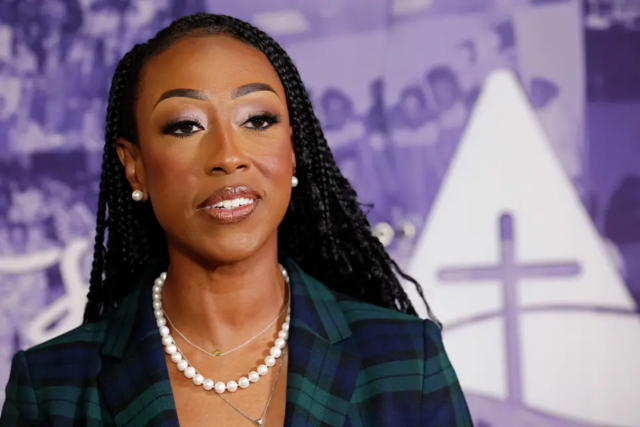
A former judge poised to become Dallas County’s top prosecutor scored a victory this week against allegations of judicial misconduct but appears to have missed the deadline for reporting donations to her ongoing political campaign.
A Special Court of Review on Thursday dismissed all sanctions against former State District Court Judge Amber Givens stemming from multiple misconduct allegations lodged against her five years ago.
The court’s six-page ruling came a little more than a year after the State Commission on Judicial Conduct handed down a public reprimand and public admonition against the former felony court judge. Givens appealed the commission’s findings and a trial was held in February at the state Supreme Court in Austin.
The decision came one day after Givens missed the Wednesday deadline to disclose her campaign’s donors and spending. Dallas County Clerk John Warren said his office has not yet received the report, potentially exposing Givens to fines every day it is delayed.
While the review court dismissed every charge collectively in the misconduct case, it provided little incident-by-incident analysis of why the evidence was insufficient.
“We conclude the Commission failed to meet its burden of proving the charged conduct by a preponderance of the evidence,” the court wrote in its opinion. “We, therefore, dismiss the Commission’s public reprimands and public admonitions.”
Givens resigned from her position presiding over the 282nd District Court in December to run for Dallas County district attorney. She defeated two-term incumbent John Creuzot in the March 3 Democratic primary and has no opponent on the November ballot.
The finance reports due Wednesday would have shown the first snapshot of who donated to Givens since she secured the victory over Creuzot. Her most recent filing in February showed $9,455 in political contributions and $1,500 in in-kind donations.
Givens didn’t respond to a text seeking comment about the court’s decision or an email about the campaign filing deadline.
“It’s obviously a complete victory for Judge Givens,” said attorney Chip Babcock, who represented her during the appeal. “As we said in our post-trial briefs, the commission did not prove any of the charges and in our view, did not come close to proving them.”
Assistant Attorneys General Brad Wurster and John Grey, who represented the commission at trial, didn’t respond to an email seeking comment.
Attorney Amanda Branan, who was president of the Dallas Criminal Defense Lawyers Association when the organization filed the complaints against Givens and was among the witnesses who testified against her, said Thursday she accepted the special court’s ruling.
“We went down to Austin and testified truthfully and we respect the decision of the court,” Branan said.
The case against Givens began in 2021 when leaders of the lawyers’ group filed two misconduct complaints against her. Another investigation was initiated the following year by the commission after Givens was accused of presiding over two criminal cases after she’d been recused, jailing a man in one case and revoking bond from another.
The other allegations included that she allowed a court coordinator to preside over a Zoom bond hearing, mistreated lawyers and litigants, showed bias against members of the Dallas Criminal Defense Lawyers Association, mishandled recusal motions and recorded a conversation with a regional judge without his knowledge.
In July 2025, the commission issued a public reprimand – the harshest sanction available – and an admonishment after its members confirmed the allegations. Givens appealed, leading to the trial earlier this year.
The review court consisted of three judges from various appellate courts in the state. Two lawyers from the attorney general’s office presented the case against Givens, and Babcock served as her lead attorney.
Givens denied the allegations in testimony before the court. She told the panel she would never have asked her court coordinator to pretend to be her, nor would she do anything that might jeopardize the career she had worked so hard for. Givens also denied being disrespectful to attorneys in her court, and said well-known issues with the rollout of a new court computer system prevented her from knowing she’d been recused from the two cases she acted on after she had been removed from them.
After the trial, the court set deadlines for the prosecution and defense to submit arguments with the last being April 24 for prosecutors. Wurster and Grey filed briefs by the first deadline but didn’t submit anything for the second one.
Among the options the panel had was to reinstate some or all the sanctions, or to dismiss them. In their filing, Wurster and Grey asked the review court to issue the harshest sanctions available.
The panel said in its opinion that testimony and evidence described Givens as “certainly a polarizing individual” but ruled that, taken as a whole, the evidence did not prove the alleged violations.
The Texas Ethics Commission issues fines for late and missing campaign finance filings, with an initial fine of $500 for the first day and $100 a day after that. The state, however, has a history of not enforcing payment of the fines.
Senior Staff Writer
Jane Harper is the senior courts reporter for the Dallas Morning News. A native of Port Arthur, she earned her journalism degree from the University of Texas at Austin and has covered the courts beat for newspapers in Texas, Maryland and Virginia. In 2021, she was named Outstanding Journalist of the Year by the Virginia Press Association.