Court transcripts of Karmelo Anthony trial appear to contradict defense attorney’s retrial affidavit
By: Sally Avila Edwards, Sana Muneer, Lola Jahant, Jamie Landers, Staff Writers
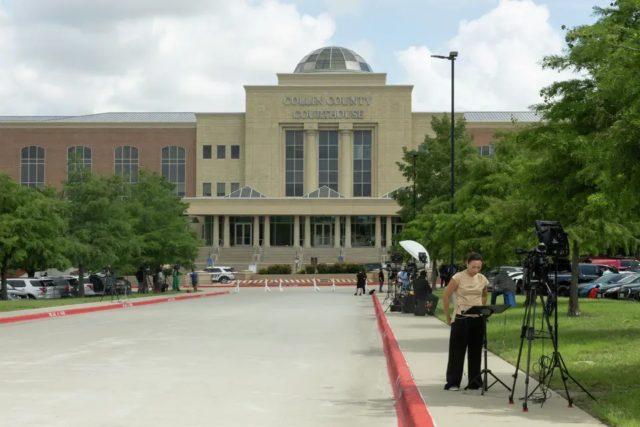
Newly obtained court records make public for the first time the discussion that preceded Karmelo Anthony’s decision not to testify in his murder trial, appearing to contradict his defense team’s assertions that the prosecution violated an informal “gentleman’s agreement” and that the judge gave the Frisco teen 10 minutes to decide whether to take the stand.
Anthony’s lead trial attorney, Mike Howard, made the allegations in a July 5 affidavit attached to a motion for a retrial filed by the teen’s appeals team. In the affidavit, Howard said the defense and prosecution made the agreement to avoid delving into the pasts and character of both Anthony and the victim, 17-year-old Austin Metcalf, during the trial.
Howard said the alleged breach, followed by what he described as District Judge John Roach Jr. giving Anthony only 10 minutes to decide whether to testify, influenced Anthony’s decision not to take the stand. The next day, Anthony, 19, was convicted of fatally stabbing Metcalf at a high school track meet in April 2025. He was sentenced to 35 years in prison.
The previously unreported transcripts, obtained by The Dallas Morning News, reveal for the first time the courtroom exchanges leading up to Anthony’s decision. The partial transcripts reveal Howard told the judge the prosecution upheld its side of the deal before Anthony came to his decision, and timestamps show Anthony had at least 30 minutes to decide if he wanted to take the stand.
“It’s gratifying to know that the transcript for the actual trial and what actually happened has been released publicly, because what actually happened in the trial record does not support many, if not all, of the allegations in Mike Howard’s affidavit,” Bill Wirskye, the case’s lead prosecutor, told The News Friday in a phone interview.
Howard, in response to questions about his comments in the transcripts where he said he believed the State had not “pulled the rug out from under us,” wrote in an email to The News that the situation was “complicated.” According to his receptionist, he was in court and unavailable Friday to return multiple phone calls and emails seeking clarification on the differences between his affidavit and the court record.
In addition to asking for a retrial, Anthony’s appellate attorneys asked to remove Roach from overseeing the post-trial proceedings, alleging statements the judge made after the verdict put his impartiality in question. Sean Daredia, an attorney on Anthony’s appeals team, did not comment when reached via text Friday afternoon.
Defense attorney’s account conflicts with trial transcript
The portions of the transcript that have been released reflect, in part, a June 8 conversation between the defense, prosecution and the judge — outside the presence of the jury — in which they discussed the terms of the gentleman’s agreement.
According to Anthony’s new trial motion, which was filed July 7, prosecutors and defense attorneys made a deal about a month before trial to focus exclusively on the day of the track meet, without introducing details about either Anthony or Metcalf’s character.
Attorneys designed the deal so both parties would avoid mentioning accusations of bullying and racism against Metcalf and his twin brother, and Anthony’s cellphone and school disciplinary records.
In his affidavit, Howard said the prosecution betrayed the deal — leaving his team with few options to make a persuasive case. “The prosecution’s breach of the agreement directly and significantly undermined the defense’s ability to present a complete defense,” he wrote.
But in the transcript, as the lawyers went back and forth about the details of Anthony’s intended testimony on June 8, Howard said he believed “both sides were acting in good faith,” despite having different understandings of the agreement.
“I agreed that that deal, for lack of a better term, has held,” he said, according to the transcript. “I believe both parties have abided by it. That deal has not changed.”
Related: At Karmelo Anthony trial, race takes center stage outside the courtroom
Court record shows Karmelo Anthony had more time to decide
Once both sides finalized the agreement, according to the transcript, Roach announced a recess so Howard could privately advise Anthony whether to testify.
In his affidavit, Howard wrote that Roach gave Anthony only 10 minutes for a conversation — “in the most stressful situation of his life” — on whether to take the witness stand in his defense. If the deal was off, as Howard said, Anthony testifying would open the door to the prosecution bringing up his personal history.
Howard wrote that he asked Roach for additional time, but Roach declined. The judge did not respond to requests for comment from The News via text and email.
The court transcripts show a longer period of time elapsed.
After Roach discussed the advantages and disadvantages of Anthony testifying on the record, nearly 30 minutes passed before Anthony informed the judge he would not testify. In that half-hour, Anthony met with Howard and his parents. If Howard made a request for additional time, it did not appear in the transcript.
In his emailed statement to The News Thursday night, Howard wrote that he had “multiple discussions” with his client on June 8, but reiterated that “the judge gave us 10 minutes to explain Karmelo’s rights to him so he could decide whether to testify or not.”
“We had to have the normal discussion lawyers have with any criminal defendant about their right to testify — which usually takes 10 minutes or more in a standard situation — plus we had to discuss the many complicating factors at play given the breach of the agreement,” he said.
Court transcripts show Anthony indicated he had enough time when Roach asked if he had sufficient time to make his decision.
“Did you think you had ample time to talk to your lawyers about that and got feedback from them, feedback from your family? You have had enough time to make that decision?” Roach asked Anthony.
“Yes, sir, we did,” Anthony replied.
“So with that, Mr. Howard, when the jury comes back in and I say call your next witness, what’s the Defense’s response?” Roach asked, according to the transcript.
“We’ll rest, Your Honor,” Howard replied.
San Antonio judge will decide whether to recuse Roach
The motion seeking to remove Roach from the case has been assigned to a San Antonio judge, according to Cynthia Wheless, the regional presiding judge for the area that includes Collin County.
Judge Sid Harle, the regional presiding judge in San Antonio, will hear arguments on whether Roach should remain on the case, Wheless said. Roach has declined to voluntarily recuse himself.
A hearing date has not been set.
Meanwhile, Metcalf’s grandfather, David Prall, said the protracted legal proceedings — and the back and forth over how the trial was conducted — are a source of continued pain for the murdered teen’s family.
“You don’t know what this has done to my family; bringing this up, claiming he [Anthony] got a raw deal,” Prall told The News Thursday. “Twelve people convicted him. That’s our justice system.”
Staff writer
Sally Avila Edwards is an intern for The Dallas Morning News. Avila Edwards covers the latest breaking and trending news about the Dallas-Fort Worth area. She graduated from Harvard with a degree in Government and English Literature. Originally from Central Texas, Avila Edwards previously reported for KXAN Austin and The Harvard Crimson.
Reporter
Sana Muneer is a breaking news intern at The Dallas Morning News. She is a student at Boston University studying journalism and psychology and is currently president of BU’s independent student newspaper, The Daily Free Press. She has previously reported for Boston Globe Media and The Dorchester Reporter.
Staff Writer
Lola Jahant is a breaking news intern at The Dallas Morning News. She graduated from the University of Missouri School of Journalism and is originally from Dallas. She has previously reported for KDFW-TV, D Magazine and the Columbia Missourian.
Senior Breaking News Reporter
Jamie Landers is the senior breaking news reporter at The Dallas Morning News, where she covers crime, courts and capital punishment. She is a graduate of The Walter Cronkite School of Journalism and Mass Communication in Phoenix, where she studied journalism and political science. Jamie previously reported for The Arizona Republic and Arizona PBS.