By vp wright
Forward Times
https://www.forwardtimes.com/
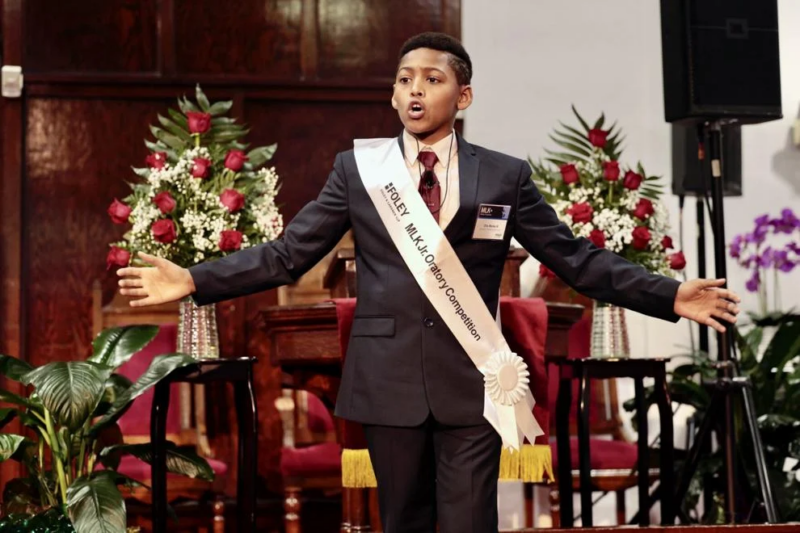
The sanctuary of Antioch Missionary Baptist Church held its breath. Inside the 160-year-old downtown Houston landmark, nine elementary school students stood ready to answer a question that has echoed through generations: “As a student of Dr. King’s life, what message of hope do you think he would have for the world today?”
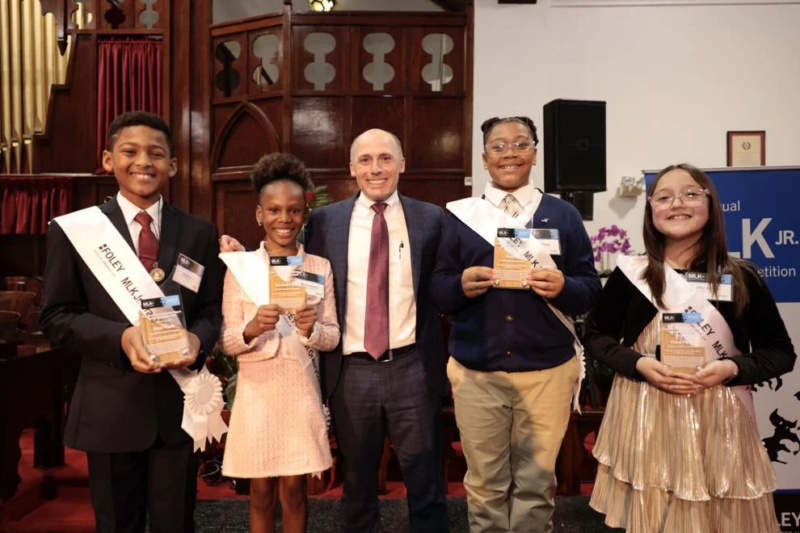
Foley Houston Managing Partner and event emcee Scott Ellis poses with the student winners of the 30th Annual Foley MLK Jr. Oratory Competition.KATY ANDERSON 281-787-3031
On Friday, January 16, 2026, Otis Marks III—a fifth-grader from Windsor Village Elementary—stepped to the podium wearing more than just his formal suit and sash. Around his neck hung a photograph of his grandmother, Marie Marks, a woman he never met but whose legacy runs through his veins like inherited fire. The scar that once marked her face, stretching from her temple downward, told a story of 1955; of lunch counter sit-ins, of peaceful protest met with police batons, of choosing love over hate even when hate answered with violence.
“If Dr. Martin Luther King Jr. were alive today,” Otis declared to the packed sanctuary, his young voice carrying the weight of generations, “I truly believe that he would say, ‘Now that you have embraced my message, take this torch and continue to make my dream come true.’”
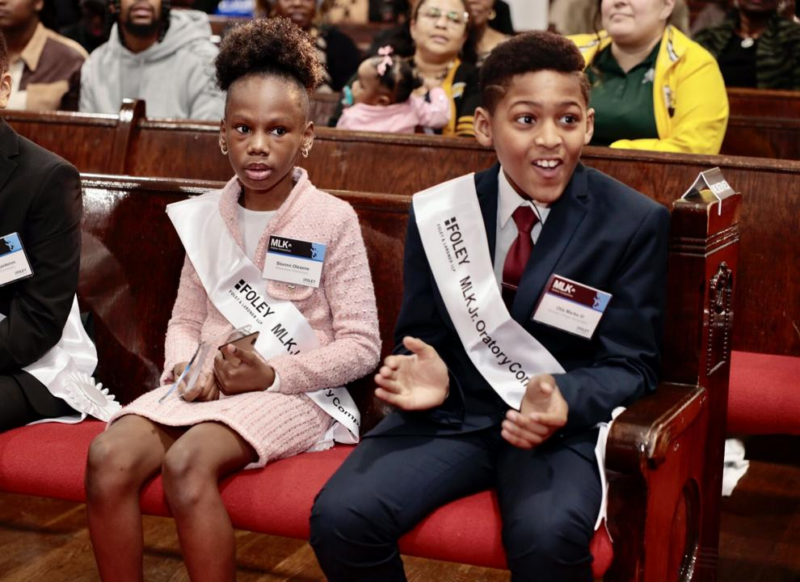
Otis Marks III (right) reacts as he is announced first-place winner, seated besideStormii Olezene, who earned second place.Katy Anderson
And then, with the confidence of someone who understands that leadership is not about age but about courage, he issued his call: “Follow me.”
When Ancestors Speak Through Their Descendants
The 30th annual Foley MLK Jr. Oratory Competition has always been more than a speaking contest. It’s a ritual of remembrance, a passing of torches, a space where Houston’s youngest voices claim their inheritance of Dr. King’s unfulfilled dream. This year, 150 students from 17 Houston ISD schools entered the competition, advancing through in-school rounds in November to earn one of nine coveted spots in the final round.
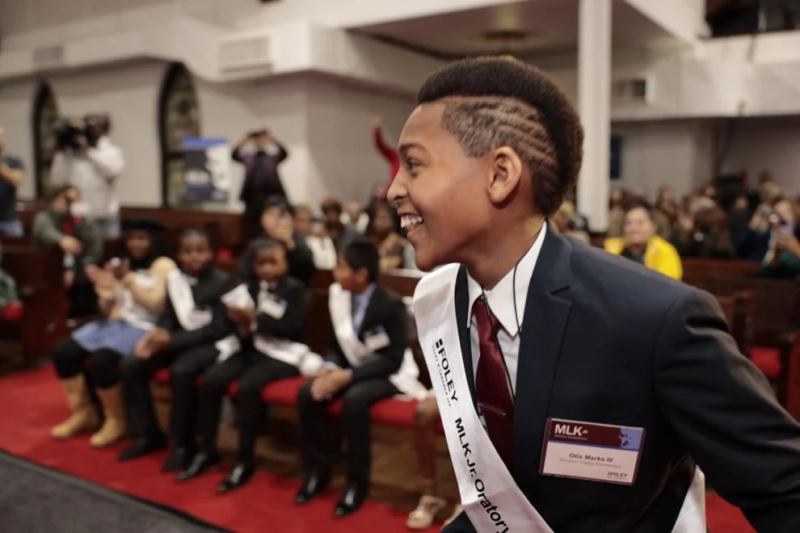
Otis Marks III smiles as he walks forward to accept his first-place plaque at the 30th Annual Foley MLK Jr. Oratory Competition.Katy Anderson
But Otis’s speech carried something particular, something urgent. He didn’t speak in abstractions about equality. He spoke in specifics: about children of all backgrounds finding refuge in this land of opportunity, about law-abiding citizens not having to hide from authorities, about a place “where ICE is only used in Kool-Aid.”
That line, delivered with the pointed clarity only a child can muster, cut through the room. Otis, as a fifth-grader, understands what his grandmother understood in 1955: that Dr. King’s dream was never meant to be comfortable. It was meant to be complete.
“Follow me to a place where Caucasians, African Americans, Hispanics, Asians, and other cultures can sit at the table of brotherhood and have no conflict nor barriers,” he continued, his voice rising. “Follow me to a place where there are no labels that divide us into people, but where we see each other as only God’s people.”
Speaking with Forward Times following his first-place win, Otis explained the moment he learned about his grandmother’s scar. “I can’t believe it’s like this,” he remembered thinking. “I can’t believe that she went through all that just to protest about this, about segregation, just to make it right, just to help people.”
His father, Otis Marks II, watching from the audience, could barely contain his emotion. “The passion—you could tell he actually was living his speech,” he said, his voice thick with pride. “When he said ‘follow me,’ I mean, I almost broke out in tears. The way he said it, I felt him.”
Bravery Measured in Broken Voices and Unbroken Spirits
Otis wasn’t the only one living his speech that Friday morning.
Monica Robledo, a fifth-grader from Patterson Elementary, took the stage and did something that no amount of preparation can teach: she chose to continue even when her own words broke her heart.
Monica spoke directly to the pain caused by the actions of ICE, the United States Immigration and Customs Enforcement, about families ripped apart, parents taken from their jobs, and children pulled from their schools—about communities living in fear, never getting the chance to say goodbye to the people they love. As she described the treatment of immigrants and undocumented citizens, her voice began to crack. Tears filled her eyes. The sanctuary, already quiet, became still.
And then Monica did what her speech demanded: she kept going.
The audience wept with her. Adults who had come to judge eloquence found themselves confronting something far more powerful—the moral clarity of a child who refused to let fear silence her truth. Monica’s bravery, pushing through emotion that would have stopped most adults, showcased a strength that transcended the competition itself. Her speech was a reminder that Dr. King’s message of hope is also a message of discomfort, that speaking truth often means speaking through tears.
When Otis mentioned ICE in his speech, he was speaking directly to Monica’s pain. When Monica described her community’s fear, she was giving flesh to Otis’s vision. Together, their speeches formed a conversation about what Dr. King’s dream demands in 2026—not just brotherhood in theory, but protection in practice.
The Intersection of Past and Present
The judging panel—featuring retired founding partner Claude Treece (who launched the competition three decades ago), Award-winning journalist Melanie Lawson, EEOC Director Rayford Irvin, and U.S. District Judge George C. Hanks, among others—faced the difficult task of measuring inspiration. How do you score a speech that carries ancestral trauma? How do you rank vulnerability against vision?
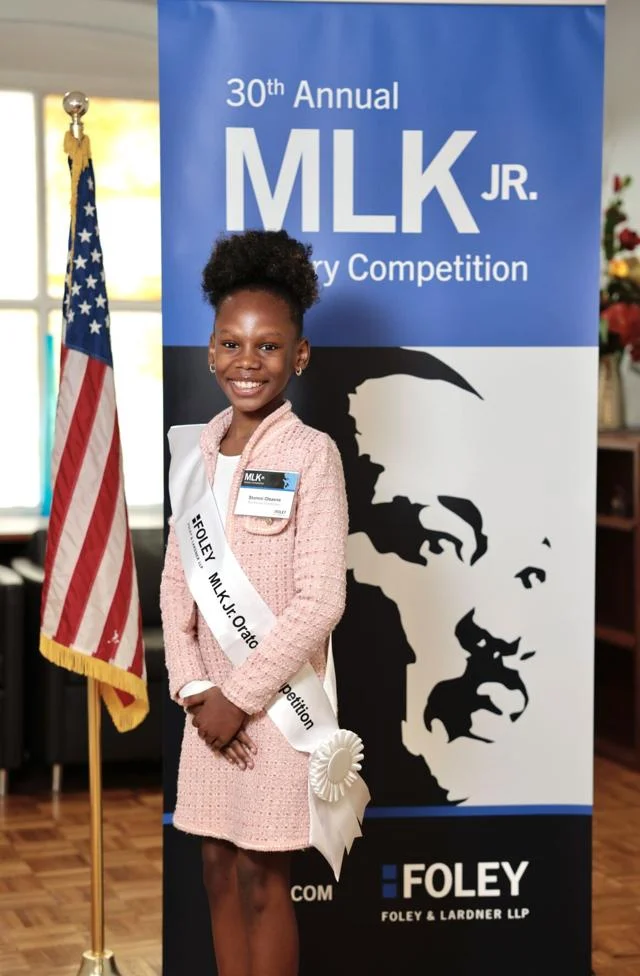
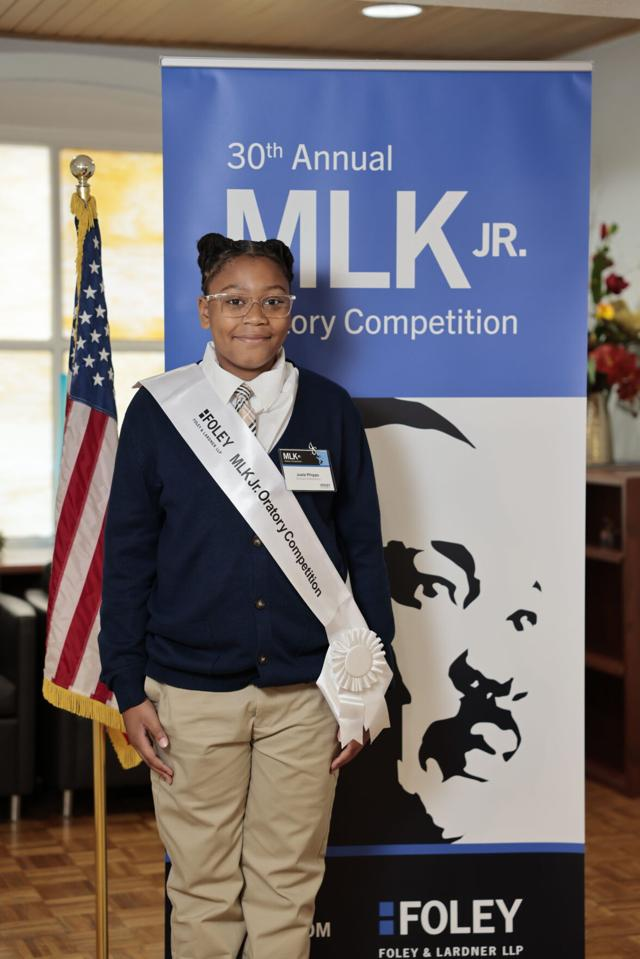
In the end, Otis Marks III claimed first place, his grandmother’s photograph still hanging around his neck. Stormii Olezene, a fourth-grader from Blackshear Elementary, and Juelz Phipps, a fifth-grader from Bonham Elementary, tied for second place. Ailani Briceno, a fifth-grader from Crespo Elementary, earned third place.
But the real victory was harder to quantify. It lived in the moment when Otis looked at his grandmother’s scar and decided her sacrifice would not be in vain. It lived in Monica’s tears and her refusal to stop speaking. It lived in the 150 students across 17 schools who spent weeks asking themselves what hope looks like in their world, in their neighborhoods, in their own lives.
Scott Ellis, Foley’s Houston Office Managing Partner and the event’s new chair, captured this perfectly: “Today reminded us all that Dr. King’s ideals are alive and well in the hearts of these students.”
The competition, which began in Dallas in 1993 and expanded to Houston in 1997 and Chicago in 2020, has become a tradition of transformation. More than 260 students participated across all three cities this year, each one wrestling with the gap between Dr. King’s dream and today’s reality.
The Torch Passes
When asked how he would carry this experience into his future, Otis didn’t hesitate: “To keep on going. If I see an opportunity, I’mma take it. I’m gonna read, I’mma research, I’mma pick which [opportunity’s] the best. Just keep on going.”
Just keep on going. It’s the advice his grandmother might have given him if she’d lived to see him stand on that stage. It’s what she did in 1955 when police batons came down. It’s what Monica did when her voice broke but her message wouldn’t.
In his speech, Otis challenged his generation with these words: “Dreams don’t build themselves—they require action, sacrifice, and everybody working as a team.”
He closed with a final call, one that echoed through Antioch Missionary Baptist Church’s 160 years of service to the Houston community: “Carry this torch with me. Carry it proudly, carry it bravely, carry it until its flames light up every corner of injustice. And let us walk side by side, step by step toward the world Dr. King knew was possible. A world of hope. A world of peace. A world where true freedom is not just empty words, but guaranteed promises.”

And then, in case anyone missed it, he reminded them of Dr. King’s message to the world: “Did you hear it? If not, don’t worry—just FOLLOW ME.”
The sanctuary erupted. Because they had heard it. In Otis’s voice, they heard Marie Marks at that lunch counter in 1955. In the courage of nine elementary school students, they heard the continuation of a movement that refuses to die.
As Antioch Missionary Baptist Church celebrated its 160th anniversary and Foley & Lardner LLP marked its 30th year of hosting the competition, the parallel was impossible to miss: institutions endure, but movements live in people. Dr. King’s dream survives not in monuments, but in fifth-graders who wear their grandmothers’ scars like badges of honor, who speak for voiceless communities through tears, who understand that hope is not passive waiting but active creation.
The torch has been passed.
And this generation is already carrying it forward.
Just follow them.